

Subscribe To Our Newsletter!
Subscribe to the newsletter to stay up to date with the latest news and most useful
Newsletter
↑
Back to Top



Product Overview |
|---|
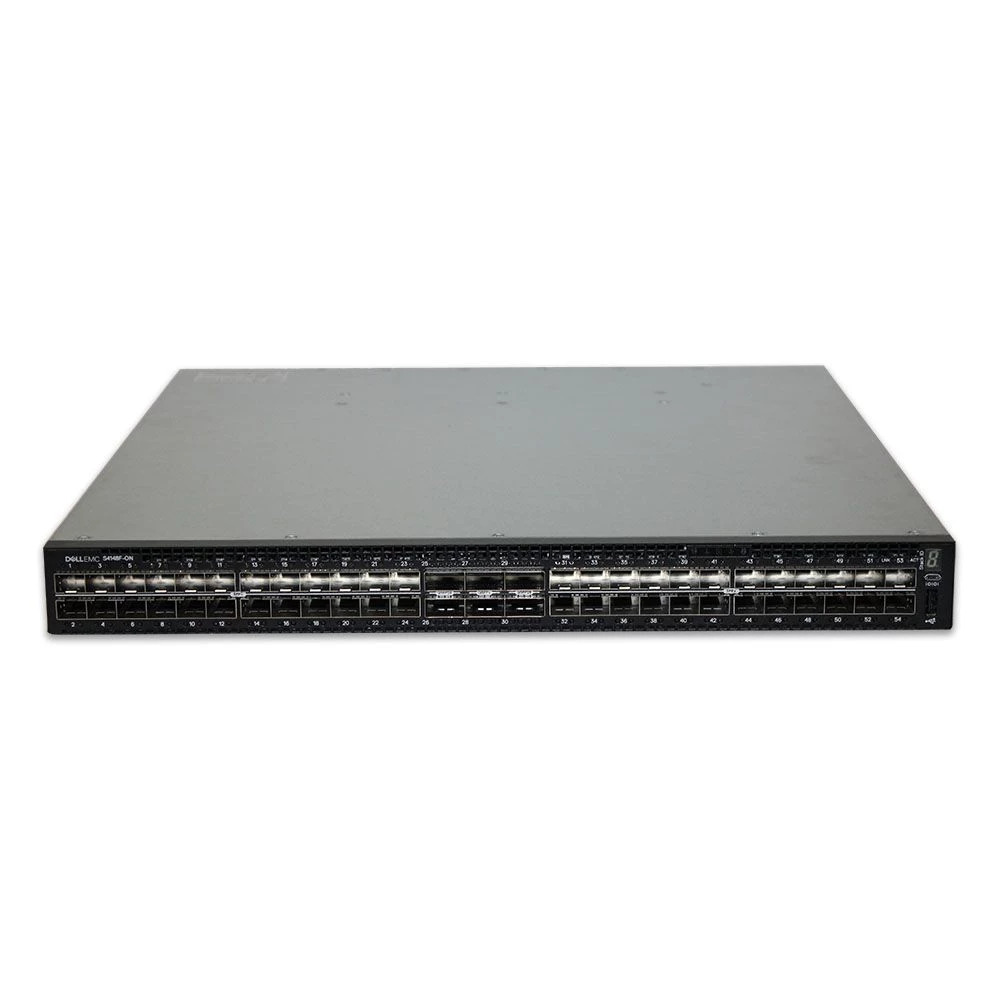
The Dell S4148f-On switch combines multiple high-speed ports with Layer 3 routing to support complex network topologies. It fits well in data centers or enterprise backbones where diverse connection options and strong routing capabilities are required for smooth network operations. |
General Information |
|
|---|---|
| Brand | Dell |
| Part Number | WT75M |
| Condition | Refurbished |
Technical Information |
|
|---|---|
| Switch Ports | 48 |
| Number of Ports | 54-Ports |
| Port Type | 40G QSFP+, 100G QSFP28, SFP+, QSFP / QSFP+, USB Console, Serial Console (RJ-45) |
| Port Speed | 10Gbps,40Gbps,100Gbps |
| UpLink Ports | 6 (4x100G QSFP28, 2x40G QSFP+) |
| POE Support | No |
| Switching Capacity | 1.92 Tbps |
| Switch Forwarding Rate | 3,750,000,000 pps (64-byte frames) |
| VLAN Support | Yes |
| Max VLANs Supported | 1-4094 |
| Stackable | No |
| Layer Support | Layer 3 |
Performance |
|
|---|---|
| Jumbo Frame Support | Up To 9216 Bytes |
Management and Configuration |
|
|---|---|
| Routing Protocols | Static, RIP |
| Remote Protocols | Yes |
| Management Interfaces | CLI (Console, SSH), Web GUI, SNMPv2/v3, REST API, RMON |
| Remote Management Protocol | SNMP, SSH, Telnet, HTTP/HTTPS, REST API |
Power & Cooling |
|
|---|---|
| Fans | 2 (hot-swappable) |
Physical Characteristics |
|
|---|---|
| Dimensions | 1.7 x 17.4 x 17.8 in (H x W x D) |
| Weight | 5.00 |
| Operating Temperature | 0°C to 40°C (32°F to 104°F) |
Miscellaneous |
|
|---|---|
| Compliance Standards | WEEE, RoHS, CE, FCC, UL, TUV |
| Compliant Standards | IEEE 802.3, IEEE 802.3ae, IEEE 802.1Q, IEEE 802.1p, IEEE 802.3ad, IEEE 802.3x, IEEE 802.1D, IEEE 802.1w, IEEE 802.1s |
Product Description |
|---|
This Dell S4148f-On switch delivers robust networking with a mix of 10G, 40G, and 100G ports, making it ideal for data centers and enterprise environments that demand high bandwidth and low latency. It is commonly used in network cores or aggregation layers to handle heavy traffic loads and complex routing tasks. Built for IT professionals and network engineers, it supports Layer 3 routing protocols that streamline data flow across different network segments. Its range of port speeds offers versatility for connecting servers, storage, and other switches, adapting to various infrastructure needs. Key Features
This switch is often deployed in data center clusters or large enterprise networks, where reliable, high-throughput switching is critical. It helps reduce congestion and improve overall network responsiveness by efficiently managing traffic across multiple high-speed links. |
 Shipping Options
 International Delivery
Requires a UPS, FedEx, or DHL account. Customers may arrange pickup from our US warehouse.
International Delivery
Requires a UPS, FedEx, or DHL account. Customers may arrange pickup from our US warehouse.
 Payment Methods
We accept Visa, Mastercard, AMEX, Discover, and Wire Transfer.
Payment Methods
We accept Visa, Mastercard, AMEX, Discover, and Wire Transfer.
 Purchase Orders
We process purchase orders for government agencies, enterprises, data centers, and SMBs.
Purchase Orders
We process purchase orders for government agencies, enterprises, data centers, and SMBs.