

Subscribe To Our Newsletter!
Subscribe to the newsletter to stay up to date with the latest news and most useful
Newsletter
↑
Back to Top



Product Overview |
|---|
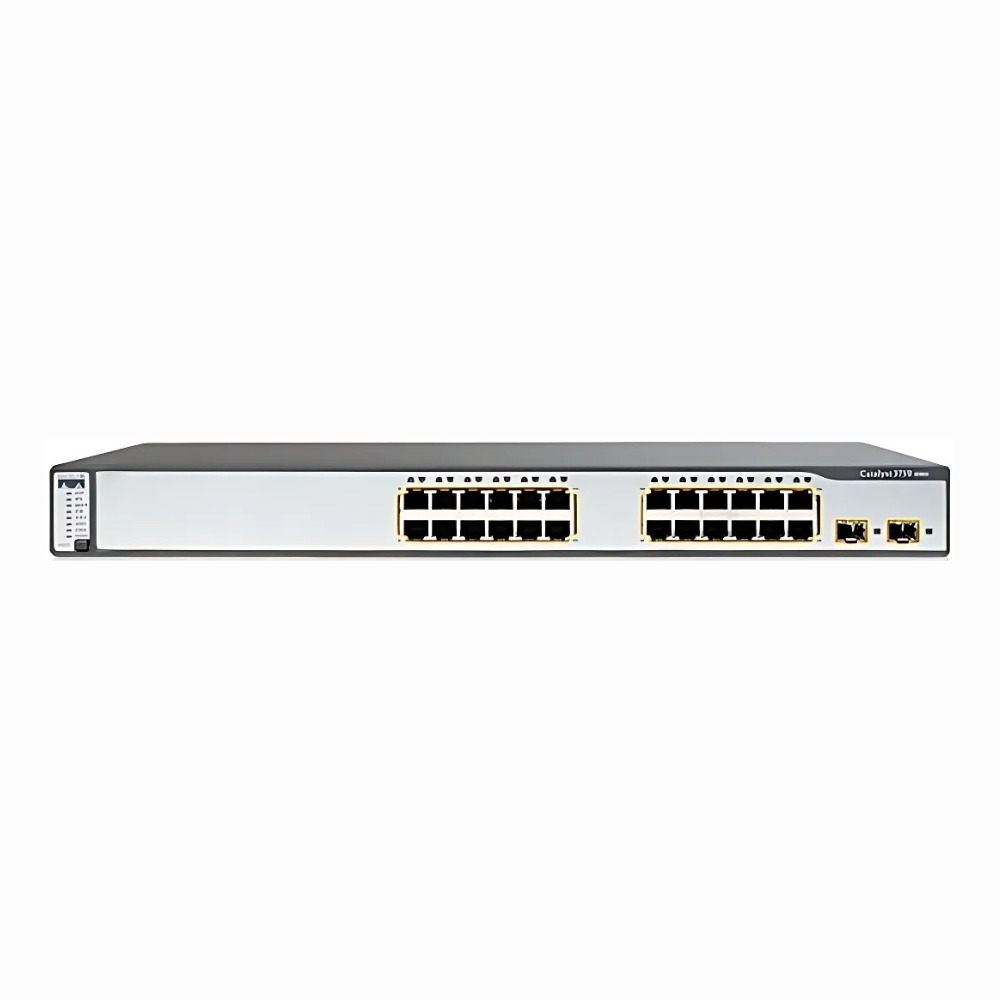
The Cisco Catalyst 3750-24TS-S provides managed Layer 3 Fast Ethernet switching with 24 RJ-45 ports and 2 SFP slots, fitting well in enterprise wiring closets and small data centers. It offers a practical mix of connectivity and routing for networks that need to segment traffic while keeping devices interconnected within a streamlined rack-mounted unit. |
General Information |
|
|---|---|
| Brand | Cisco |
| Part Number | WS-C3750-24TS-S |
| Condition | Refurbished |
Technical Information |
|
|---|---|
| Switch Ports | 24 |
| Number of Ports | 24-Ports |
| Port Type | 10/100Base-TX, SFP, Serial Console (RJ-45) |
| Port Speed | 10/100 Mbps |
| UpLink Ports | 2 |
| POE Support | No |
| VLAN Support | Yes |
| Max VLANs Supported | 1-4094 |
| NIM Slot | 9 |
| Stackable | Yes |
| Layer Support | Layer 3 |
| Connector Type | RJ-45,SFP |
Performance |
|
|---|---|
| Jumbo Frame Support | Up To 9216 Bytes |
| MAC Address Table Size | 8000 |
Management and Configuration |
|
|---|---|
| Routing Protocols | Static, RIP, OSPF, VRRP, HSRP, IGMP |
| Remote Protocols | Yes |
| Management Interfaces | CLI (Console/SSH/Telnet), Web UI (HTTP/HTTPS), SNMP v1/v2c/v3, RMON |
| Security | Yes |
| Remote Management Protocol | SSH,Telnet,HTTP,HTTPS,SNMP |
| Routing Protocol | Static,RIP,OSPF,VRRP,HSRP,IGMP |
Power & Cooling |
|
|---|---|
| Power | AC 100-240V, 50/60 Hz |
Physical Characteristics |
|
|---|---|
| Dimensions | 1.73 x 17.5 x 17.7 inches |
| Weight | 5.00 |
| Operating Temperature | 32 to 104°F (0 to 40°C) |
Miscellaneous |
|
|---|---|
| Compliance Standards | WEEE, RoHS, CE, FCC, UL, cULus |
| Compliant Standards | IEEE 802.3, IEEE 802.3u, IEEE 802.1Q, IEEE 802.1p, IEEE 802.1D, IEEE 802.1w, IEEE 802.3x |
Product Description |
|---|
The Cisco Catalyst 3750-24TS-S is a managed Fast Ethernet switch designed for medium-sized networks requiring a balance of performance and flexibility. It is commonly deployed in enterprise environments where both wired device connectivity and inter-VLAN routing are needed. Network administrators benefit from its combined switching and routing features, making it suitable for departmental networks or wiring closets. Key Features
This model typically appears in business networks where efficient traffic handling and scalability are important. Its role often involves linking multiple subnets within a secure and manageable infrastructure, helping maintain smooth communication between users and servers. |
 Shipping Options
 International Delivery
Requires a UPS, FedEx, or DHL account. Customers may arrange pickup from our US warehouse.
International Delivery
Requires a UPS, FedEx, or DHL account. Customers may arrange pickup from our US warehouse.
 Payment Methods
We accept Visa, Mastercard, AMEX, Discover, and Wire Transfer.
Payment Methods
We accept Visa, Mastercard, AMEX, Discover, and Wire Transfer.
 Purchase Orders
We process purchase orders for government agencies, enterprises, data centers, and SMBs.
Purchase Orders
We process purchase orders for government agencies, enterprises, data centers, and SMBs.