

Subscribe To Our Newsletter!
Subscribe to the newsletter to stay up to date with the latest news and most useful
Newsletter
↑
Back to Top



Product Overview |
|---|
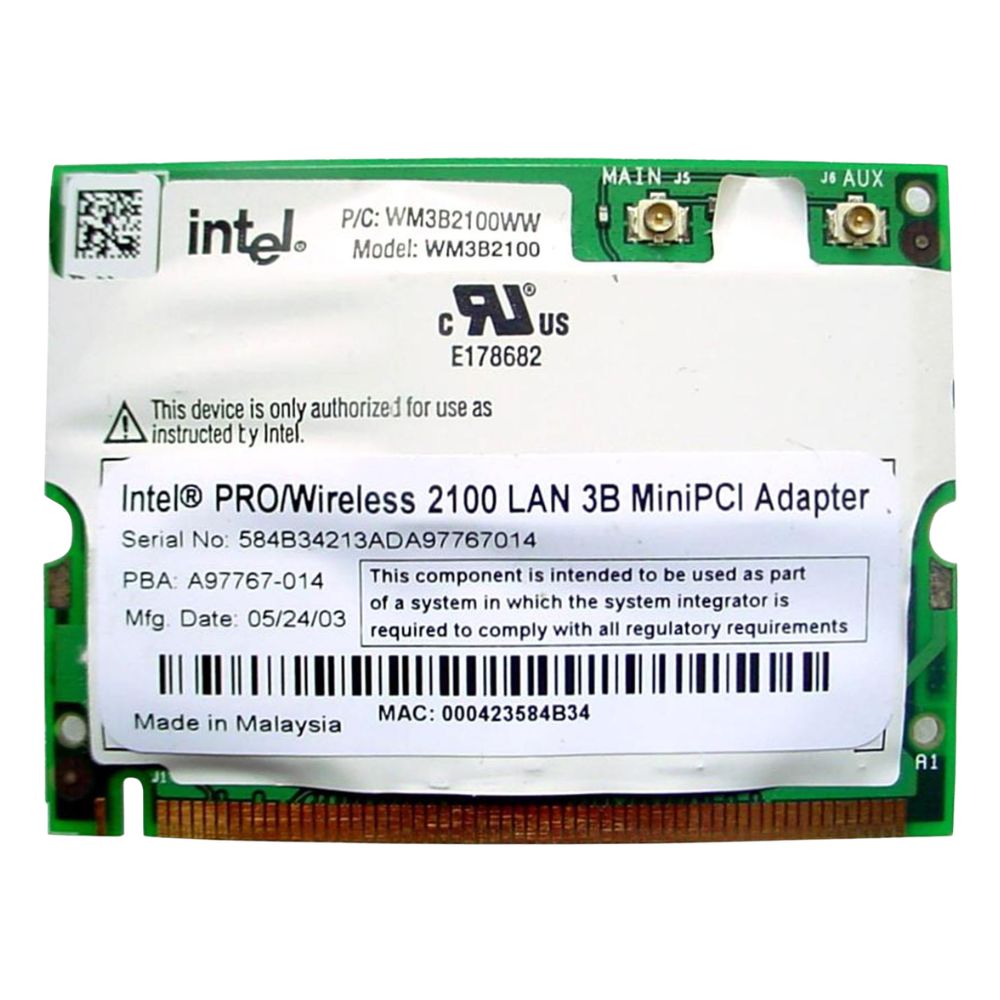
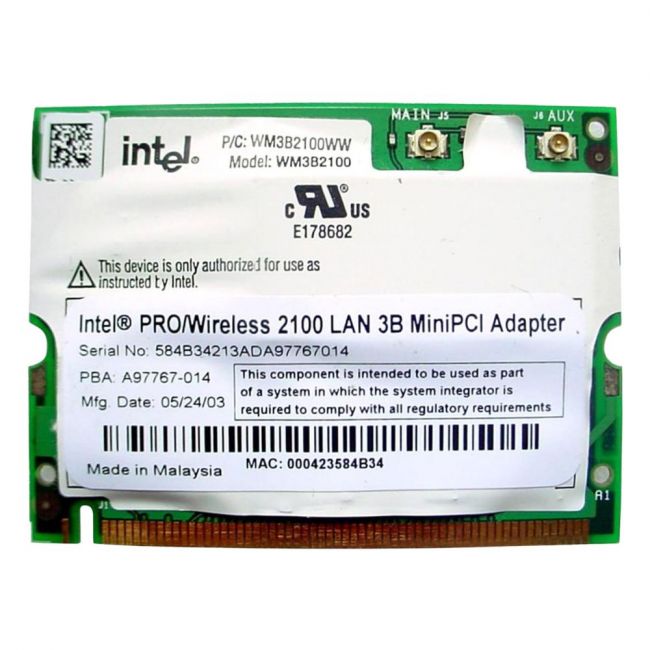
The Intel WM3B2100 is a Mini PCI wireless LAN card that provides 11Mbps Wi-Fi connectivity for embedded and mobile computing devices. It fits Mini PCI slots and supports the 802.11b wireless networking standard, making it suitable for compact system integration where wireless access is needed. |
General Information |
|
|---|---|
| Brand | Intel |
Technical Information |
|
|---|---|
| Product Type | Wireless Network Card |
| Chipset/Controller | Intel PRO/Wireless 2100 |
| Data Center Bridging | No |
Connectivity & Physical |
|
|---|---|
| Weight | 3.00 |
| Condition | Refurbished |
Miscellaneous |
|
|---|---|
| Assembly Required | No |
| Compliance Standards | WEEE, RoHS, CE, FCC |
Product Description |
|---|
The Intel WM3B2100 is a Mini PCI wireless LAN network interface card (NIC) designed to provide Wi-Fi connectivity at a data rate of 11Mbps. It is typically used in embedded systems, laptops, and compact computing platforms requiring wireless networking capabilities. This card supports the 802.11 standard, allowing devices to connect to wireless networks for data communication without physical cabling. It is commonly integrated into systems where space constraints make Mini PCI cards advantageous. Key Features
This wireless LAN NIC serves as a fundamental component for enabling wireless network access in devices where Mini PCI slots are available. It facilitates connectivity in environments requiring standard 802.11b communication at 11Mbps speeds. |
Use Cases |
|---|
The Intel WM3B2100 wireless LAN NIC is typically used in embedded systems, laptops, and compact computing devices that require wireless connectivity via a Mini PCI interface. It is most relevant in environments where 802.11b networks are deployed and moderate data rates meet operational needs. How It's Used:
This card’s role is to provide wireless network access for compatible devices, enabling them to communicate over 802.11b networks. It is suited for applications where higher-speed wireless standards are not required or available. |
FAQ's |
|---|
|
 Shipping Options
 International Delivery
Requires a UPS, FedEx, or DHL account. Customers may arrange pickup from our US warehouse.
 Payment Methods
We accept Visa, Mastercard, AMEX, Discover, and Wire Transfer.
 Purchase Orders
We process purchase orders for government agencies, enterprises, data centers, and SMBs.