

Subscribe To Our Newsletter!
Subscribe to the newsletter to stay up to date with the latest news and most useful
Newsletter
↑
Back to Top



Product Overview |
|---|
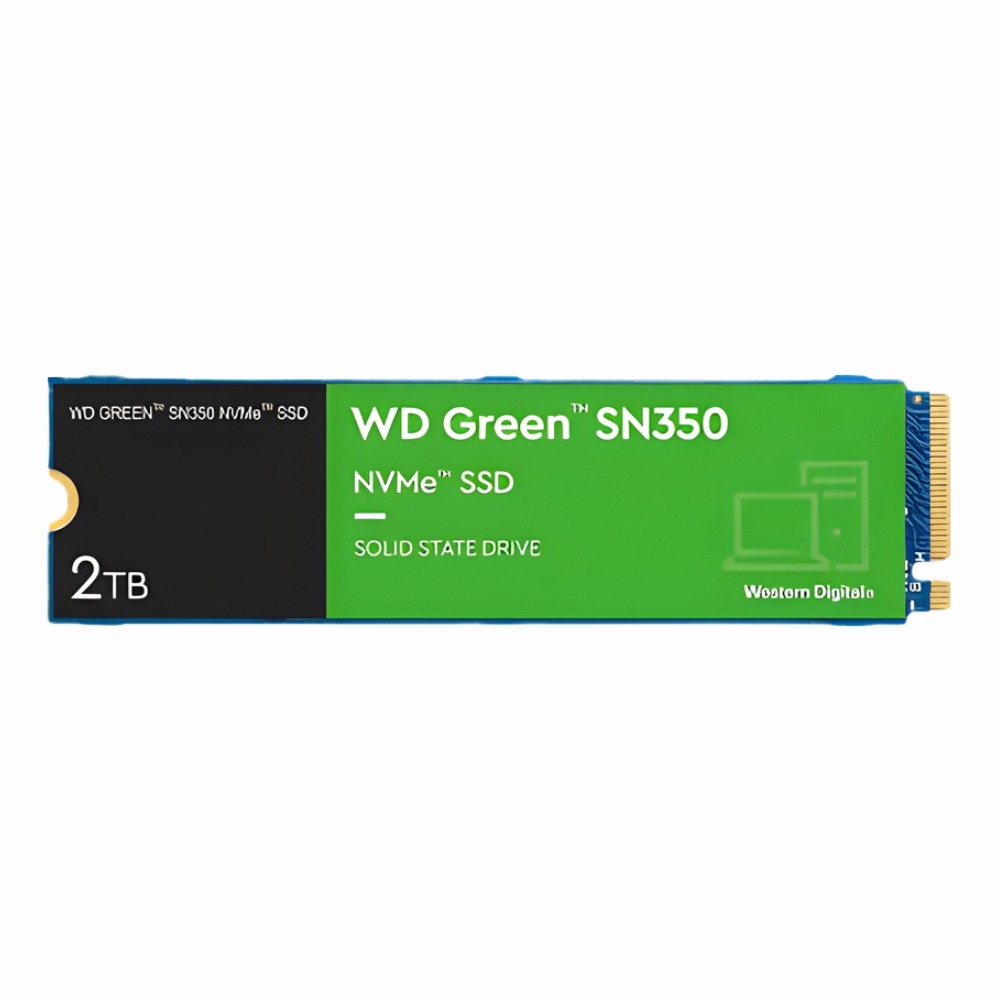
The Western Digital Green SN350 2TB SSD offers spacious and efficient storage in an M.2 2280 form factor. It fits into PCIe 3.0 x4 slots and is built for general computing needs rather than demanding workloads. This drive is a practical choice for users looking to boost their system’s storage without overcomplicating the setup or investing in premium performance features. |
General Information |
|
|---|---|
| Brand | Western Digital |
| Part Number | WDS200T3G0C |
Technical Information |
|
|---|---|
| Capacity | 2TB |
| NAND Flash | Quad-Level Cell (QLC) |
| Memory Technology | Quad-Level Cell (QLC) |
| Form Factor | M.2 2280 |
| Interface | PCIe Gen 3.0 x4 |
| Cache | DRAM-less (uses SLC cache; Host Memory Buffer (HMB) supported) |
| Hot Swappable | No |
| Hot Pluggable | No |
Physical Characteristics |
|
|---|---|
| Dimensions | 2.38 x 22.0 x 80.0 mm |
| Weight | 1.10 |
| Condition | Refurbished |
Miscellaneous |
|
|---|---|
| Eco Friendly | Yes |
| Compliance Standards | WEEE, RoHS, CE, FCC |
Product Description |
|---|
The Western Digital Green SN350 is a solid-state drive designed to provide reliable storage with ample space. It’s commonly used in desktop PCs and laptops to upgrade storage capacity and improve overall system responsiveness. The drive leverages Quad-Level Cell (QLC) NAND, offering a balance of cost-effectiveness and performance for everyday computing tasks. Built for users who need large storage without high-end gaming or intensive workloads, this SSD fits well in home or office setups. It often supports storing documents, media files, and applications with consistent access times. Key Features
This SSD is typically found in everyday computing environments where budget-friendly, high-capacity storage is needed. It plays a solid role in extending the life of older machines or providing simple storage expansion without the complexity of higher-tier drives. |
Use Cases |
|---|
The Western Digital Green SN350 2TB SSD is optimized for general computing environments where cost-effective storage expansion is needed without sacrificing basic performance. It is well-suited for small to medium business workstations and budget-conscious end-user systems that require reliable data storage rather than intensive throughput or endurance. How It's Used:
This SSD supports operational efficiency by delivering a balance of capacity and energy-efficient storage that aligns with environments emphasizing scalability and practicality over premium performance. Its compatibility with PCIe NVMe 3.0 interfaces ensures seamless integration into existing infrastructure without requiring additional configuration complexity. |
 Shipping Options
 International Delivery
Requires a UPS, FedEx, or DHL account. Customers may arrange pickup from our US warehouse.
International Delivery
Requires a UPS, FedEx, or DHL account. Customers may arrange pickup from our US warehouse.
 Payment Methods
We accept Visa, Mastercard, AMEX, Discover, and Wire Transfer.
Payment Methods
We accept Visa, Mastercard, AMEX, Discover, and Wire Transfer.
 Purchase Orders
We process purchase orders for government agencies, enterprises, data centers, and SMBs.
Purchase Orders
We process purchase orders for government agencies, enterprises, data centers, and SMBs.