

Subscribe To Our Newsletter!
Subscribe to the newsletter to stay up to date with the latest news and most useful
Newsletter
↑
Back to Top



Product Overview |
|---|
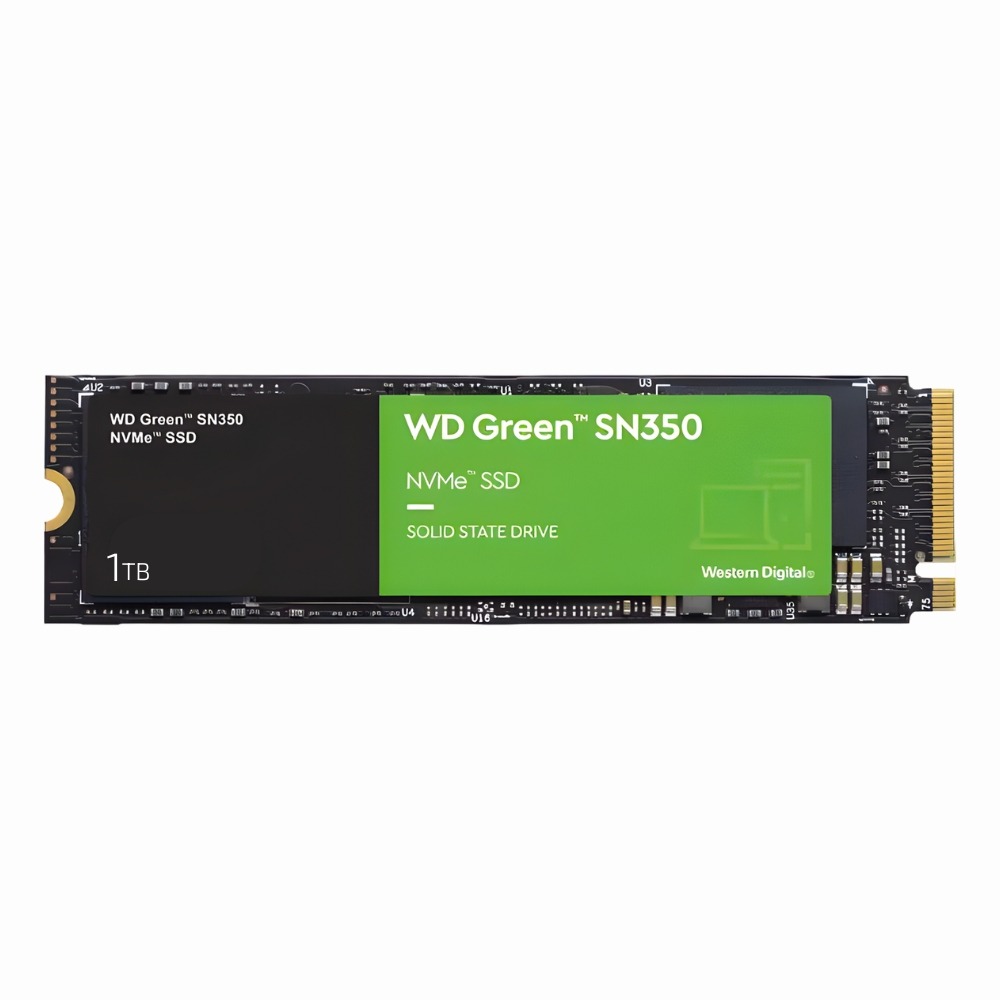
The Western Digital Green SN350 1TB SSD offers a solid balance of storage capacity and energy efficiency. It fits neatly into systems that support M.2 2280 drives and uses the NVMe 3.0 x4 interface to provide steady data transfer rates. This drive is suited for general purpose computing rather than high-performance workloads, making it a good choice for users seeking reliable everyday storage. |
General Information |
|
|---|---|
| Brand | Western Digital |
| Part Number | WDS100T3G0C |
Technical Information |
|
|---|---|
| Capacity | 1TB |
| NAND Flash | Quad-Level Cell (QLC) |
| Memory Technology | Quad-Level Cell (QLC) |
| Form Factor | M.2 2280 |
| Interface | PCIe Gen 3.0 x4 |
| Hot Swappable | No |
| Hot Pluggable | No |
Physical Characteristics |
|
|---|---|
| Dimensions | 22 mm x 80 mm x 2.38 mm |
| Weight | 1.10 |
| Condition | Refurbished |
Miscellaneous |
|
|---|---|
| Compliance Standards | WEEE, RoHS, CE, FCC |
Product Description |
|---|
The Western Digital Green SN350 is a solid state drive designed to provide ample storage with efficient performance. It offers 1TB of space, making it a practical choice for everyday computing tasks and moderate storage needs. Often found in laptops and desktops where balance between speed and power consumption matters, this SSD uses QLC NAND technology to pack more data efficiently. It's built for users who want a reliable, cost-effective storage upgrade without prioritizing extreme performance. Key Features
This SSD is commonly deployed in budget-conscious laptops and desktop PCs, serving users who need dependable storage without high-end speed demands. It's useful for storing documents, media files, and typical applications while maintaining low power consumption. In practical setups, it helps improve boot times and file access compared to spinning drives, making it a sensible upgrade for many everyday computing scenarios. |
Use Cases |
|---|
The Western Digital Green SN350 1TB SSD is commonly integrated into entry-level desktops and compact workstations requiring reliable storage without excessive power consumption. It is particularly suitable for environments where energy efficiency is prioritized over peak performance, such as office automation or basic multimedia editing tasks. How It's Used:
This SSD supports operational efficiency by delivering steady performance while minimizing energy consumption, facilitating scalable deployment across distributed environments. Its form factor and interface allow flexible integration in systems where space and power are constrained, ensuring balanced storage solutions in diverse low-to-mid-range computing scenarios. |
 Shipping Options
 International Delivery
Requires a UPS, FedEx, or DHL account. Customers may arrange pickup from our US warehouse.
International Delivery
Requires a UPS, FedEx, or DHL account. Customers may arrange pickup from our US warehouse.
 Payment Methods
We accept Visa, Mastercard, AMEX, Discover, and Wire Transfer.
Payment Methods
We accept Visa, Mastercard, AMEX, Discover, and Wire Transfer.
 Purchase Orders
We process purchase orders for government agencies, enterprises, data centers, and SMBs.
Purchase Orders
We process purchase orders for government agencies, enterprises, data centers, and SMBs.