

Subscribe To Our Newsletter!
Subscribe to the newsletter to stay up to date with the latest news and most useful
Newsletter
↑
Back to Top



Product Overview |
|---|
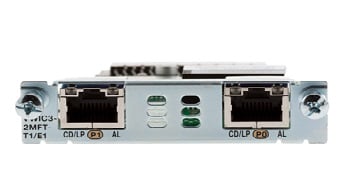
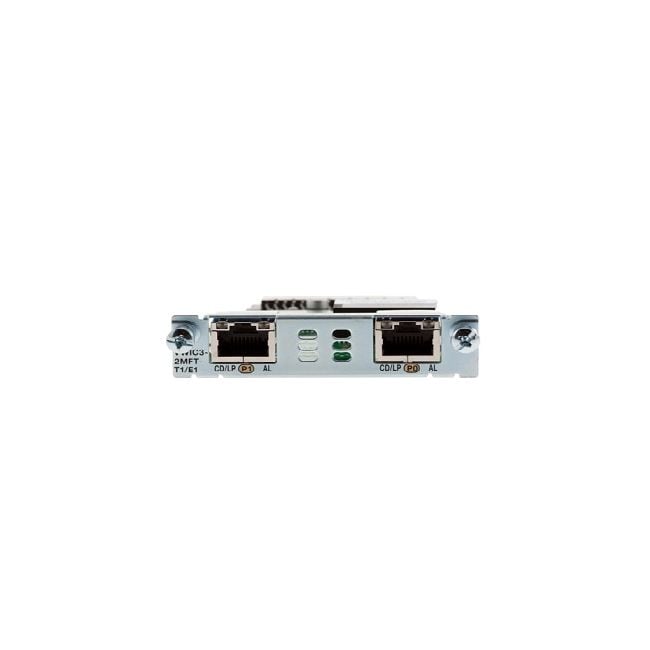
The VWIC3-2MFT-T1/E1 is a two-port voice WAN interface card designed to handle both T1 and E1 lines. It fits into Cisco routers to provide flexible voice and data connectivity options, supporting various telephony setups and WAN configurations typical in enterprise and service provider environments. |
General Information |
|
|---|---|
| Brand | Cisco |
| Part Number | VWIC3-2MFT-T1/E1 |
Technical Information |
|
|---|---|
| Ports | 2 |
| Compatibility | Cisco routers that support VWIC3 modules (VWIC3-compatible ISR and modular platforms; e.g., many Cisco ISR and legacy modular routers) |
| Data Transfer Rate | T1: 1.544 Mbps per port; E1: 2.048 Mbps per port |
| Connector Type | RJ-48C (2 x RJ-48C) |
Physical Characteristics |
|
|---|---|
| Weight | 5.00 |
| Condition | Refurbished |
Miscellaneous |
|
|---|---|
| Assembly Required | Yes |
| Eco Friendly | Yes |
Product Description |
|---|
This voice WAN interface card provides two ports capable of handling T1 and E1 lines, allowing for robust voice and data transmission. Often found in enterprise networks, it facilitates multiple voice channels while maintaining reliable data performance. Built for Cisco routers, the card enables adaptable WAN setups with its multiflex trunk capabilities, making it a solid choice for voice network engineers and IT professionals managing telephony integration. Key Features
This interface card is frequently deployed in corporate branch offices and service provider networks where multiple voice channels need to be aggregated efficiently. By consolidating voice and data over a single hardware interface, it helps reduce equipment complexity and streamlines network management. |
Use Cases |
|---|
The VWIC3-2MFT-T1/E1 module is primarily utilized in enterprise and service provider networks requiring reliable voice and data transmission over T1/E1 lines. Organizations with legacy telephony infrastructures or mixed WAN environments benefit from its dual-port flexibility and multiflex trunk capabilities, making it suitable for complex network topologies and diverse connectivity demands. How It's Used:
This interface card enhances operational efficiency by consolidating multiple T1/E1 connections within a single hardware module, facilitating scalable network growth and simplifying WAN infrastructure. Its adaptability to various telephony and data configurations supports consistent performance in dynamic and evolving network environments. |
 Shipping Options
 International Delivery
Requires a UPS, FedEx, or DHL account. Customers may arrange pickup from our US warehouse.
International Delivery
Requires a UPS, FedEx, or DHL account. Customers may arrange pickup from our US warehouse.
 Payment Methods
We accept Visa, Mastercard, AMEX, Discover, and Wire Transfer.
Payment Methods
We accept Visa, Mastercard, AMEX, Discover, and Wire Transfer.
 Purchase Orders
We process purchase orders for government agencies, enterprises, data centers, and SMBs.
Purchase Orders
We process purchase orders for government agencies, enterprises, data centers, and SMBs.