

Subscribe To Our Newsletter!
Subscribe to the newsletter to stay up to date with the latest news and most useful
Newsletter
↑
Back to Top



Product Overview |
|---|
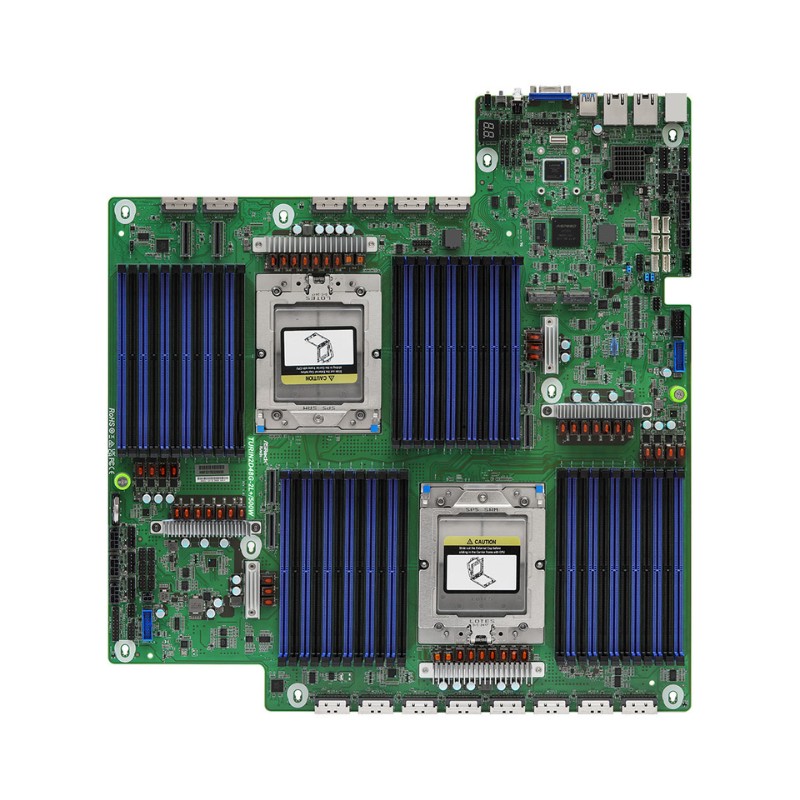
The TURIN2D48G-2L+ ASRock Rack motherboard is a dual-socket SP5 platform aimed at enterprise servers needing high memory density and multiple expansion slots. It fits in data centers demanding reliability and flexibility, making it well-suited for virtualization, cloud services, and large-scale computing tasks. |
General Information |
|
|---|---|
| Brand | ASRock |
| Part Number | TURIN2D48G-2L+ |
| Product Type | Server Motherboard |
Technical Information |
|
|---|---|
| Compatible Processors | Supports AMD EPYC™ 9005*/9004 (with AMD 3D V-Cache™ Technology) and 97x4 series processors |
| Board Socket Type | Dual Socket SP5 (LGA 6096) |
| Memory Slots | 24+24 DIMM slots (2DPC) |
| Memory Support | 48 DIMM slots (24 per processor), supports DDR5 RDIMM and RDIMM-3DS |
| Storage Interfaces | Supports 2 M.2 (PCIe3.0 x4 or SATA 6Gb/s) |
| Expansion Slots | 12 MCIO (PCIe 5.0 / CXL 2.0 x8), 4 MCIO (PCIe 5.0 / CXL 2.0 x8 or 8 SATA 6Gb/s), 2 MCIO (PCIe 5.0 x8), 2 MCIO (PCIe 5.0 x8) |
Physical Characteristics |
|
|---|---|
| Form Factor | Proprietary |
| Dimensions | 18" x 16.9" |
| Weight | 11.68 |
| Condition | Refurbished |
Miscellaneous |
|
|---|---|
| Assembly Required | Yes |
| Eco Friendly | Yes |
| Compliance Standards | WEEE, RoHS, cURus, CE, FCC, CCC, UL, TUV, cULus, CSA, cUL |
Product Description |
|---|
The TURIN2D48G-2L+ is a server motherboard designed to handle intensive computing tasks by supporting dual AMD EPYC processors. It's built for data centers and enterprises needing reliable and scalable performance. Often found in high-density server racks, this motherboard caters to system builders and IT professionals who require large memory support and advanced connectivity options for virtualization, databases, and cloud computing. Key Features
This motherboard is typically deployed in enterprise servers where uptime and scalability are critical. It enables organizations to run complex applications and virtual machines efficiently. Its broad memory and expansion capabilities help future-proof infrastructure while supporting diverse workloads without compromising performance. |
 Shipping Options
 International Delivery
Requires a UPS, FedEx, or DHL account. Customers may arrange pickup from our US warehouse.
International Delivery
Requires a UPS, FedEx, or DHL account. Customers may arrange pickup from our US warehouse.
 Payment Methods
We accept Visa, Mastercard, AMEX, Discover, and Wire Transfer.
Payment Methods
We accept Visa, Mastercard, AMEX, Discover, and Wire Transfer.
 Purchase Orders
We process purchase orders for government agencies, enterprises, data centers, and SMBs.
Purchase Orders
We process purchase orders for government agencies, enterprises, data centers, and SMBs.