

Subscribe To Our Newsletter!
Subscribe to the newsletter to stay up to date with the latest news and most useful
Newsletter
↑
Back to Top



| Product Overview |
|---|
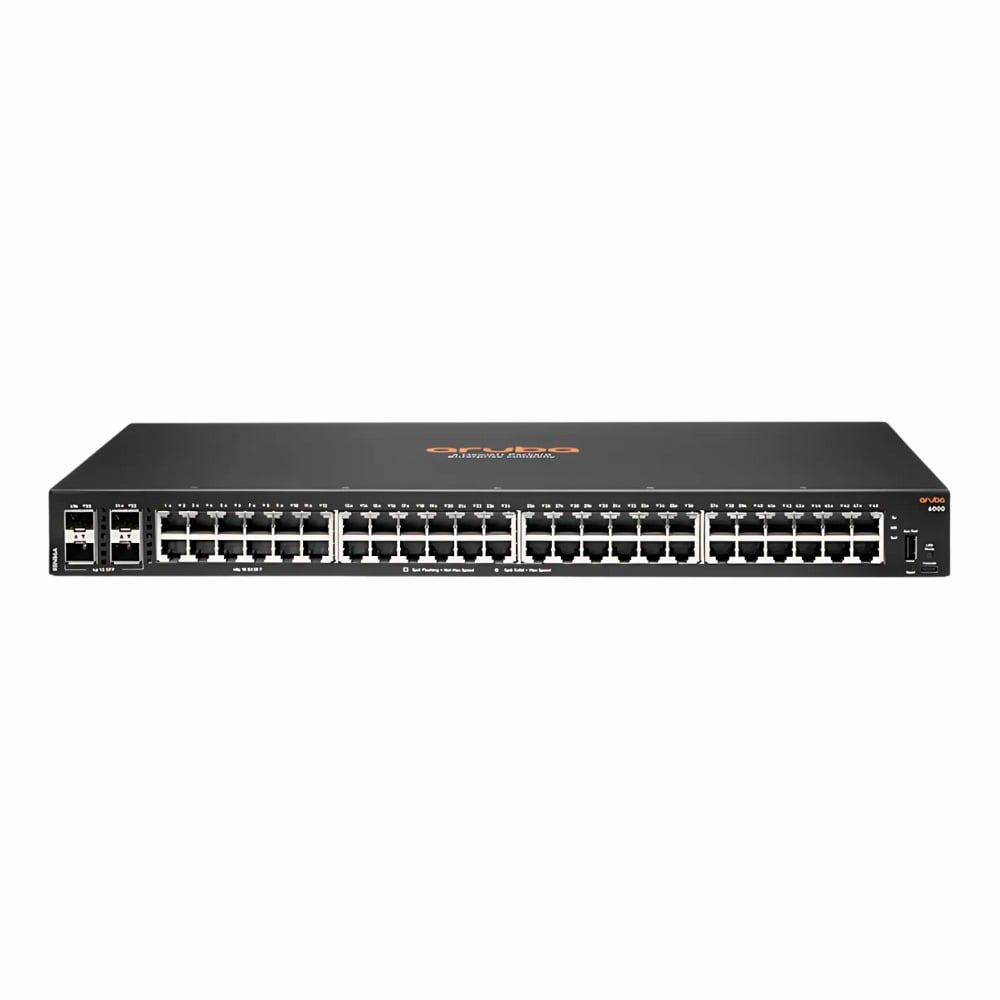
The HP Aruba 6000 Series 48G switch is a managed Layer 3 device designed for enterprises needing reliable Gigabit Ethernet connections. It fits into standard racks and balances port density with fiber uplink flexibility, making it suitable for core network roles or aggregation layers in many setups. |
| General Information | |
|---|---|
| Brand | Aruba |
| Part Number | R8N86-61001 |
| Condition | Refurbished |
| Technical Information | |
|---|---|
| Switch Ports | 48 |
| Number of Ports | 48-Ports |
| Port Type | 1000Base-T, SFP |
| Port Speed | 1 Gbps |
| UpLink Ports | 4 |
| POE Support | No |
| VLAN Support | Yes |
| Max VLANs Supported | 4094 |
| Layer Support | Layer 3 |
| Connector Type | RJ-45,SFP |
| Performance | |
|---|---|
| Jumbo Frame Support | Up To 9216 Bytes |
| Management and Configuration | |
|---|---|
| Routing Protocols | Static, RIP, OSPF, VRRP, IGMP |
| Remote Protocols | Yes |
| Management Interfaces | Web GUI,CLI (Console),SSH,SNMP,REST API |
| Remote Management Protocol | SSH,HTTPS,HTTP,SNMP,REST |
| Physical Characteristics | |
|---|---|
| Weight | 5.00 |
| Miscellaneous | |
|---|---|
| Compliance Standards | WEEE, RoHS, CE, FCC |
| Product Description |
|---|
The HP Aruba 6000 Series 48G switch provides robust network performance with 48 copper Gigabit ports and 4 SFP fiber uplinks. This device is often found in enterprise networks where reliable wired connections and advanced Layer 3 routing are essential. Built for IT professionals managing medium to large scale environments, it supports efficient traffic handling and network segmentation. Its rack-mountable form factor fits neatly in server rooms or wiring closets, making it a practical choice for structured cabling setups. Key Features
This switch is typically deployed in business network backbones or campus environments where stable, managed Gigabit Ethernet connectivity is a must. It helps maintain smooth communications across devices and supports varied network topologies without complexity. |
| Use Cases |
|---|
The HP Aruba 6000 Series 48G switch is typically deployed in mid to large enterprise networks where high port density and versatile uplink options are essential. It serves IT teams managing data center aggregation layers or campus core switches, supporting environments that require robust Layer 3 routing and reliable Gigabit Ethernet connectivity for varied workloads. How It's Used:
This switch facilitates operational efficiency by consolidating multiple Gigabit endpoints with advanced routing in a scalable rack-mount form factor. Its combination of copper and fiber ports allows seamless adaptation to evolving network topologies, ensuring sustained performance in dynamic enterprise and data center environments. |
 Shipping Options
 International Delivery
Requires a UPS, FedEx, or DHL account. Customers may arrange pickup from our US warehouse.
International Delivery
Requires a UPS, FedEx, or DHL account. Customers may arrange pickup from our US warehouse.
 Payment Methods
We accept Visa, Mastercard, AMEX, Discover, and Wire Transfer.
Payment Methods
We accept Visa, Mastercard, AMEX, Discover, and Wire Transfer.
 Purchase Orders
We process purchase orders for government agencies, enterprises, data centers, and SMBs.
Purchase Orders
We process purchase orders for government agencies, enterprises, data centers, and SMBs.