

Subscribe To Our Newsletter!
Subscribe to the newsletter to stay up to date with the latest news and most useful
Newsletter
↑
Back to Top



Product Overview |
|---|
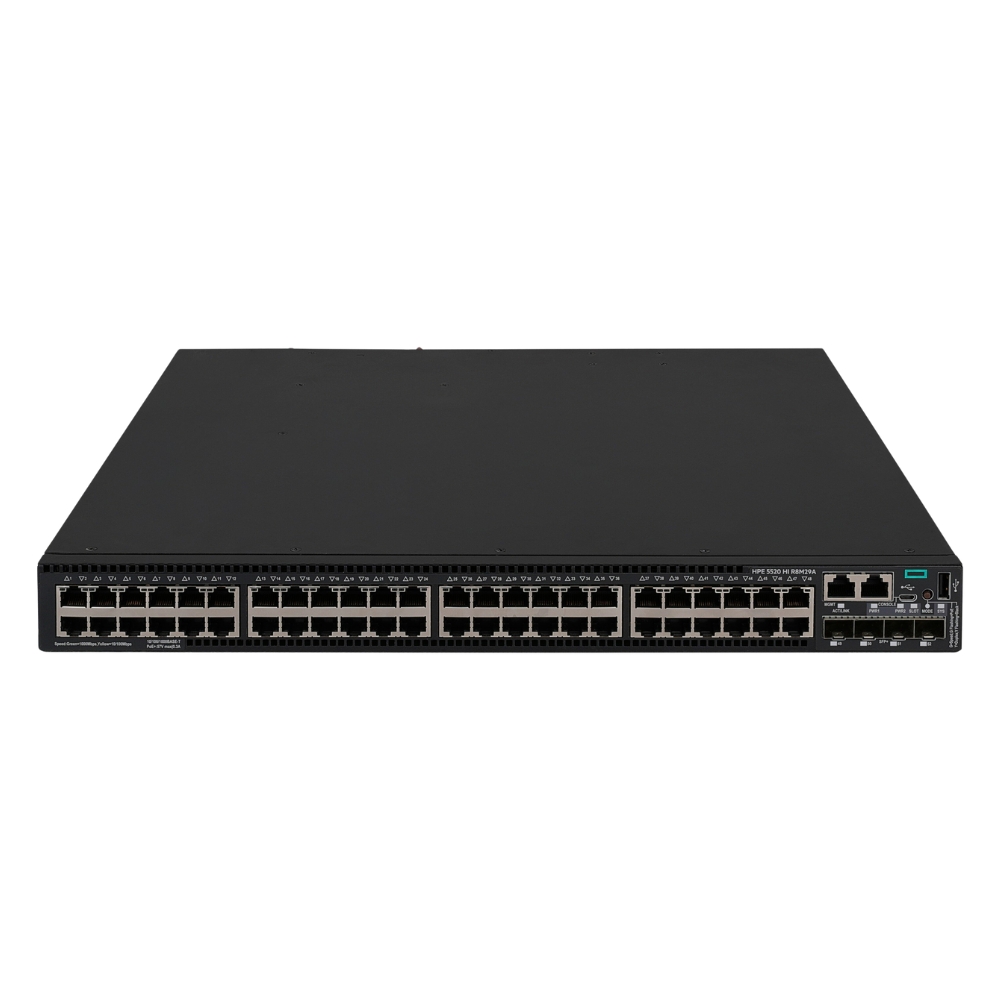
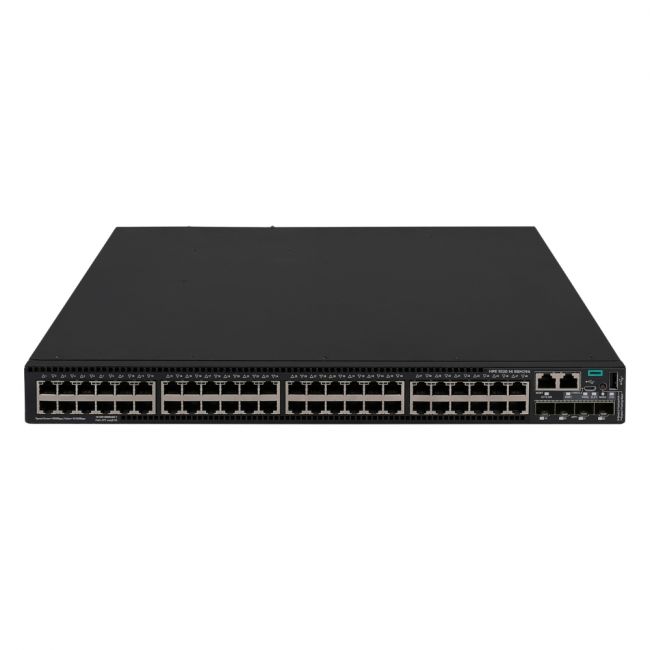
The HP FlexNetwork 5520 48G PoE+ switch delivers a combination of high-density gigabit connectivity with PoE+ support and enhanced uplink speeds via 10GbE SFP+ ports. It fits standard racks and offers Layer 3 capabilities that support routing and network segmentation. This switch is suited for environments requiring both power delivery and advanced network management. |
General Information |
|
|---|---|
| Brand | HP |
| Condition | Refurbished |
Technical Information |
|
|---|---|
| Switch Type | Layer 3, Managed Switch, Stackable Switch, PoE Switch, Gigabit Switch |
| Form Factor | Rack-Mountable |
| Mount Type | 1U Rack |
| Switch Ports | 48 |
| Number of Ports | 48-Ports |
| Port Type | 10/100/1000Base-T, 10G SFP+, Serial Console (RJ-45) |
| Port Speed | 10/100/1000 Mbps,10 Gbps |
| UpLink Ports | 4 |
| POE Support | PoE+ |
| Switching Capacity | 176 Gbps |
| Switch Forwarding Rate | 343.75 Mpps |
| DRAM | 512 MB |
| Flash Memory | 128 MB |
| VLAN Support | Yes |
| Max VLANs Supported | 1-4094 |
| Stackable | Optional |
| Layer Support | Layer 3 |
| Connector Type | RJ-45,SFP+,USB Console |
Performance |
|
|---|---|
| Jumbo Frame Support | Up To 9216 Bytes |
| MAC Address Table Size | 32000 |
Management and Configuration |
|
|---|---|
| Routing Protocols | Static, RIP, OSPF, VRRP, PIM-SM, IGMP |
| Remote Protocols | Yes |
| Management Interfaces | Web GUI, Command Line (CLI), SNMP, SSH, Telnet, Console (RJ-45/USB), RMON |
| Security Features | ACLs, 802.1X, RADIUS, TACACS+, MAC filtering, Port security, DHCP snooping, IP Source Guard, Storm control |
| Management Type | Managed |
| Remote Management Protocol | SNMPv1/v2c/v3, HTTP/HTTPS, SSH, Telnet, RMON |
| Routing Protocol | Static,RIP,OSPF,VRRP,IGMP,PIM-SM |
Power & Cooling |
|
|---|---|
| Fans | Hot-swappable, variable speed |
| Power | 100-240 VAC input, PoE budget 740 W |
| Power Supply | Internal AC power supply |
Physical Characteristics |
|
|---|---|
| Weight | 3.00 |
| Operating Temperature | 0°C to 45°C |
Miscellaneous |
|
|---|---|
| Assembly Required | No |
| Compliance Standards | WEEE, RoHS, CE, FCC, UL, cULus |
| Compliant Standards | IEEE 802.3, IEEE 802.3u, IEEE 802.3ab, IEEE 802.3ae, IEEE 802.1Q, IEEE 802.1p, IEEE 802.1D, IEEE 802.3x, IEEE 802.1s, IEEE 802.1w |
Product Description |
|---|
The HP FlexNetwork 5520 48G PoE+ is a managed Layer 3 switch designed to handle intensive network traffic with 48 gigabit ports offering Power over Ethernet Plus. It provides enhanced connectivity options with four 10GbE SFP+ ports, enabling fast uplinks and network backbone integration. This switch is often found in enterprise networking environments and data centers where both power delivery and high throughput are critical. Built for IT professionals and network administrators, this device supports complex network topologies and routing protocols, making it ideal for medium to large scale networks. Its rack-mountable design fits seamlessly into standard 19-inch racks, facilitating organized infrastructure deployment. Key Features
This switch offers a dependable and scalable solution for networks requiring high port density and power delivery. Its Layer 3 features improve traffic flow and reduce bottlenecks, while PoE+ eliminates the need for separate power sources for connected devices. Overall, this model balances performance and manageability, serving as a core component in robust network infrastructures where reliability and uptime are essential. |
Use Cases |
|---|
This switch is typically deployed in enterprise networks, data centers, and campus environments where powering devices directly from the switch simplifies infrastructure. It suits IT teams managing diverse workloads needing reliable power and high throughput. How It's Used:
Its combination of port density, PoE+ power, and advanced Layer 3 features help maintain network efficiency and scalability. The switch's design ensures smooth operation under demanding network loads while providing centralized management options. |
 Shipping Options
 International Delivery
Requires a UPS, FedEx, or DHL account. Customers may arrange pickup from our US warehouse.
International Delivery
Requires a UPS, FedEx, or DHL account. Customers may arrange pickup from our US warehouse.
 Payment Methods
We accept Visa, Mastercard, AMEX, Discover, and Wire Transfer.
Payment Methods
We accept Visa, Mastercard, AMEX, Discover, and Wire Transfer.
 Purchase Orders
We process purchase orders for government agencies, enterprises, data centers, and SMBs.
Purchase Orders
We process purchase orders for government agencies, enterprises, data centers, and SMBs.