

Subscribe To Our Newsletter!
Subscribe to the newsletter to stay up to date with the latest news and most useful
Newsletter
↑
Back to Top



Product Overview |
|---|
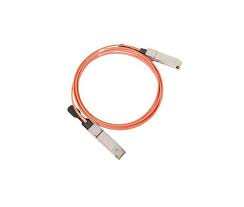
The HPE R6F25A 200Gb QSFP56 to 2x100Gb QSFP56 Active Optical Cable enables splitting one 200Gb link into two separate 100Gb connections. It's ideal for extending optical connections in data centers where HPE switches and devices are used, providing a straightforward way to increase connection density without additional hardware. |
General Information |
|
|---|---|
| Brand | HP |
Technical Information |
|
|---|---|
| Data Rate | 200Gbps (aggregate), 100Gbps per breakout (2 x 100Gb) |
| Cable Length | 5 m |
| Compatibility | HPE switches and devices with QSFP56 ports, QSFP56-compliant devices (supports breakout to 2x100Gb) |
| Stacking Bandwidth | 200Gbps |
| product type | HPE R6F25A 200Gb QSFP56 to 2x100Gb QSFP56 5m Active Optical Cable, Active Optical Cable (AOC), Breakout Cable |
| Product Category | Cables & Adapters,Cables,Active Optical Cable |
Connectivity |
|
|---|---|
| Connector Type | QSFP56 (1x) to QSFP56 (2x breakout) |
Physical Characteristics |
|
|---|---|
| Form Factor | QSFP56 to 2xQSFP56 breakout AOC, 5m |
| Weight | 5.00 |
| Condition | Refurbished |
Product Description |
|---|
This active optical cable splits a single 200Gb QSFP56 connection into two 100Gb QSFP56 ports, enabling efficient high-speed data transfer. It is commonly used in data centers and enterprise networks where bandwidth aggregation and flexible cabling are needed. Built for network engineers and IT professionals managing high-performance switches and servers, this cable provides reliable optical connectivity over 5 meters, reducing electrical interference and cabling complexity. Key Features
These cables are often found connecting core switches and high-speed storage or compute nodes in data centers. They help optimize network design by splitting high-bandwidth ports without extra transceivers, simplifying hardware setups. Using this cable can reduce port exhaustion and improve connectivity flexibility while maintaining the high speeds necessary for demanding workloads. |
 Shipping Options
 International Delivery
Requires a UPS, FedEx, or DHL account. Customers may arrange pickup from our US warehouse.
International Delivery
Requires a UPS, FedEx, or DHL account. Customers may arrange pickup from our US warehouse.
 Payment Methods
We accept Visa, Mastercard, AMEX, Discover, and Wire Transfer.
Payment Methods
We accept Visa, Mastercard, AMEX, Discover, and Wire Transfer.
 Purchase Orders
We process purchase orders for government agencies, enterprises, data centers, and SMBs.
Purchase Orders
We process purchase orders for government agencies, enterprises, data centers, and SMBs.