

Subscribe To Our Newsletter!
Subscribe to the newsletter to stay up to date with the latest news and most useful
Newsletter
↑
Back to Top



Product Overview |
|---|
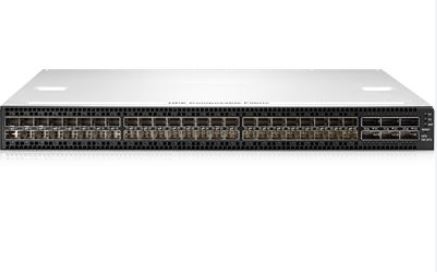
The HP Composable Fabric FM 2072 is a high-density Layer 3 switch designed for data centers and enterprise networks requiring both 10GbE and 40GbE connectivity. It fits into composable fabric architectures to provide flexible, scalable network infrastructure while maintaining efficient cooling with its back-to-front airflow setup. |
General Information |
|
|---|---|
| Brand | HPE |
| Part Number | R0Y49A |
| Condition | Refurbished |
Technical Information |
|
|---|---|
| Switch Ports | 48 |
| Number of Ports | 48-Ports |
| Port Type | SFP+, QSFP / QSFP+ |
| Port Speed | 10Gbps,40Gbps |
| UpLink Ports | 6 |
| POE Support | No |
| Switching Capacity | 1.44 Tbps |
| Switch Forwarding Rate | 2812.5 Mpps |
| VLAN Support | Yes |
| Layer Support | Layer 3 |
| Connector Type | SFP+,QSFP |
Performance |
|
|---|---|
| Jumbo Frame Support | Up To 9216 Bytes |
Management and Configuration |
|
|---|---|
| Routing Protocols | Static, OSPF, BGP, VRRP, PIM-SM, IGMP |
Physical Characteristics |
|
|---|---|
| Weight | 5.00 |
Miscellaneous |
|
|---|---|
| Compliance Standards | RoHS, CE, FCC |
Product Description |
|---|
This HP Composable Fabric FM 2072 switch is built for environments that require dense, high-performance network connectivity. It offers a mix of 48 SFP+ ports and 6 QSFP ports, making it well-suited for aggregating multiple 10GbE and 40GbE links in one device. Often found in data centers and enterprise networks, this switch supports Layer 3 routing to handle complex traffic efficiently. Designed for IT professionals managing scalable and flexible infrastructures, the switch integrates into composable fabric systems, simplifying network provisioning and scaling. Its back-to-front airflow suits rack setups that demand effective cooling and space management. Key Features
This switch is commonly deployed in large data centers or enterprise environments where flexible and high-capacity networking is critical. It helps maintain smooth data flow and simplifies network scaling as demands grow. Its design and feature set support long-term infrastructure stability and adaptability without constant hardware changes. |
Use Cases |
|---|
The HP Composable Fabric FM 2072 switch is ideally deployed in modern data center environments where high-density 10GbE and 40GbE connectivity is essential. It best serves enterprises and cloud service providers requiring flexible, scalable network fabrics with efficient cooling and advanced routing functionality. How It's Used:
This switch enhances operational efficiency by enabling flexible network topologies and scalable fabric management, while its Layer 3 capabilities support complex routing in demanding enterprise and cloud infrastructures. The back-to-front airflow design also ensures compatibility with established data center cooling strategies, sustaining performance in high-density deployments. |
 Shipping Options
 International Delivery
Requires a UPS, FedEx, or DHL account. Customers may arrange pickup from our US warehouse.
International Delivery
Requires a UPS, FedEx, or DHL account. Customers may arrange pickup from our US warehouse.
 Payment Methods
We accept Visa, Mastercard, AMEX, Discover, and Wire Transfer.
Payment Methods
We accept Visa, Mastercard, AMEX, Discover, and Wire Transfer.
 Purchase Orders
We process purchase orders for government agencies, enterprises, data centers, and SMBs.
Purchase Orders
We process purchase orders for government agencies, enterprises, data centers, and SMBs.