

Subscribe To Our Newsletter!
Subscribe to the newsletter to stay up to date with the latest news and most useful
Newsletter
↑
Back to Top



Product Overview |
|---|
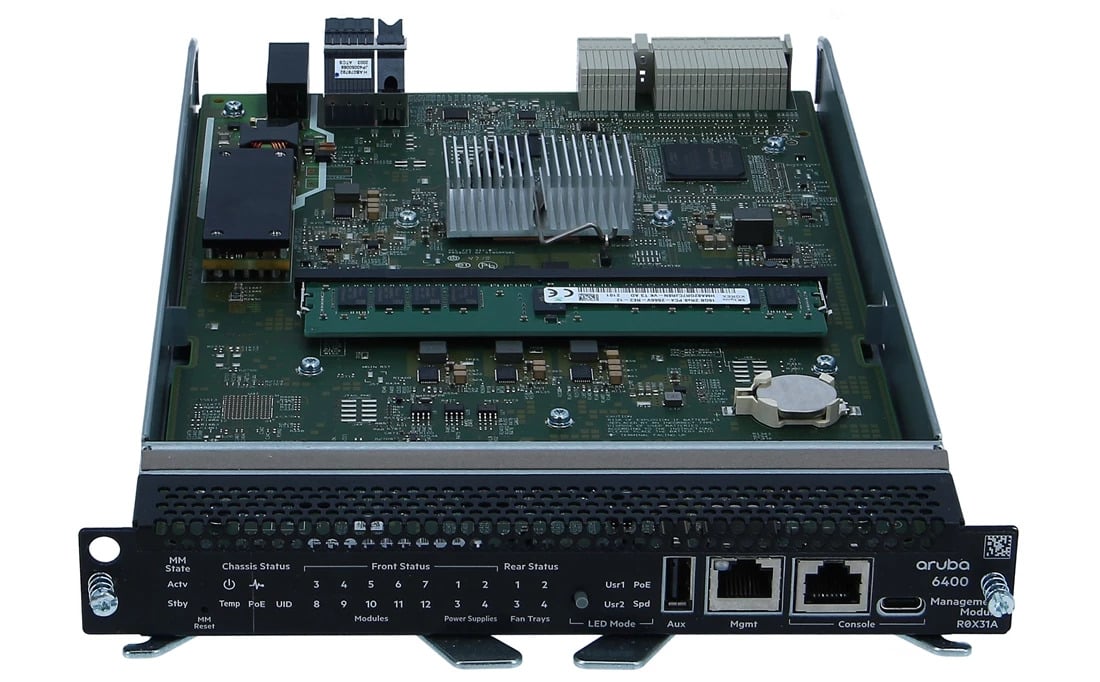
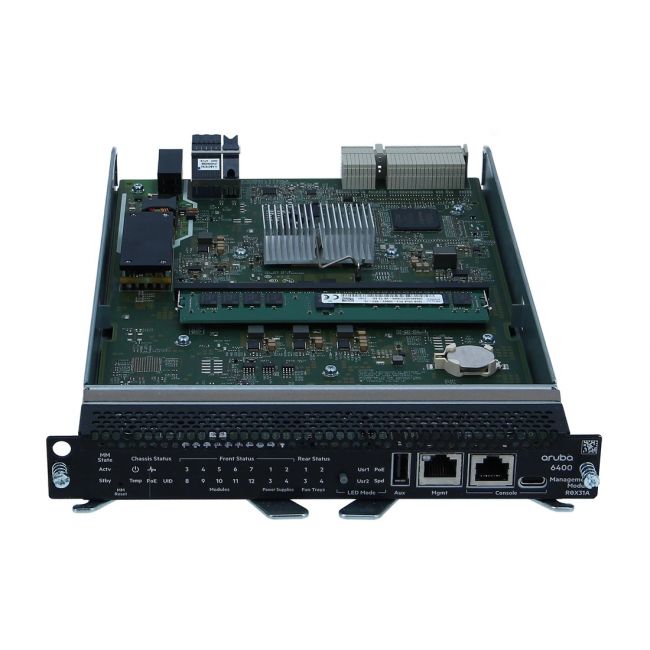
The HPE Aruba 6400 Management Module acts as the core controller for the Aruba 6400 switch chassis, handling configuration, monitoring, and overall network management tasks. It fits naturally into mid-to-large scale enterprise networks, providing a dependable platform to keep network operations running smoothly without unnecessary complexity. |
General Information |
|
|---|---|
| Brand | HPE |
| Part Number | R0X31-61101 |
| Condition | Refurbished |
Technical Information |
|
|---|---|
| Port Type | RJ-45, USB Console, Serial Console (RJ-45) |
| POE Support | No |
| VLAN Support | Yes |
| Stackable | No |
| Layer Support | Layer 3 |
Performance |
|
|---|---|
| Jumbo Frame Support | Up To 9216 Bytes |
Management and Configuration |
|
|---|---|
| Remote Protocols | Yes |
| Management Interfaces | CLI,Web GUI (HTTP/HTTPS),SSH,SNMP,REST API |
| Security Features | RADIUS,TACACS+,802.1X,ACLs,SSH,SSL |
| Management Type | Out-of-band,In-band |
| Remote Management Protocol | SNMP,SSH,HTTPS,REST |
Physical Characteristics |
|
|---|---|
| Weight | 5.00 |
Miscellaneous |
|
|---|---|
| Compliance Standards | WEEE, RoHS, CE, FCC, cULus |
Product Description |
|---|
The HPE Aruba 6400 Management Module serves as the central brain for Aruba 6400 switch chassis, providing streamlined management and oversight of network functions. Built for enterprise and campus environments, it enables IT teams to configure, monitor, and troubleshoot multiple switches from a single point. Often found in data centers and large-scale network setups, this module is designed to enhance network visibility and simplify administration. Network administrators and engineers benefit from its comprehensive control features and robust reliability. Key Features
In practice, this management module is deployed within enterprise networks to ensure smooth operation and quick response to network events. It plays a key role in maintaining network stability and enabling efficient resource allocation. |
Use Cases |
|---|
The HPE Aruba 6400 Management Module is primarily deployed in enterprise network environments where centralized control and high availability are critical. IT administrators managing mid-to-large scale campus or data center networks benefit from its robust management capabilities and support for advanced protocols, enabling streamlined network operations and maintenance. How It's Used:
By consolidating network management functions, the Aruba 6400 Management Module enhances operational efficiency and scalability. Its design supports complex network topologies while ensuring consistent performance and simplified administration in demanding IT environments. |
 Shipping Options
 International Delivery
Requires a UPS, FedEx, or DHL account. Customers may arrange pickup from our US warehouse.
International Delivery
Requires a UPS, FedEx, or DHL account. Customers may arrange pickup from our US warehouse.
 Payment Methods
We accept Visa, Mastercard, AMEX, Discover, and Wire Transfer.
Payment Methods
We accept Visa, Mastercard, AMEX, Discover, and Wire Transfer.
 Purchase Orders
We process purchase orders for government agencies, enterprises, data centers, and SMBs.
Purchase Orders
We process purchase orders for government agencies, enterprises, data centers, and SMBs.