

Subscribe To Our Newsletter!
Subscribe to the newsletter to stay up to date with the latest news and most useful
Newsletter
↑
Back to Top



Product Overview |
|---|
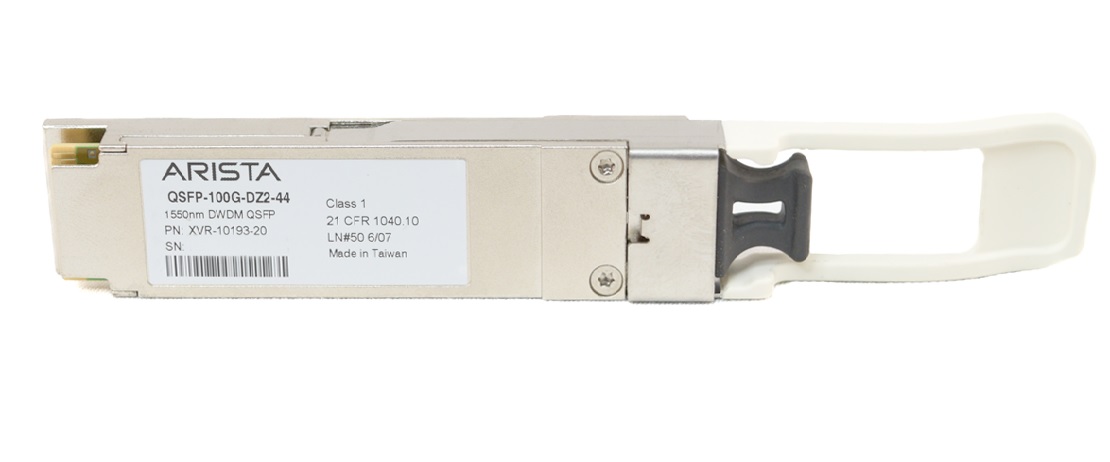
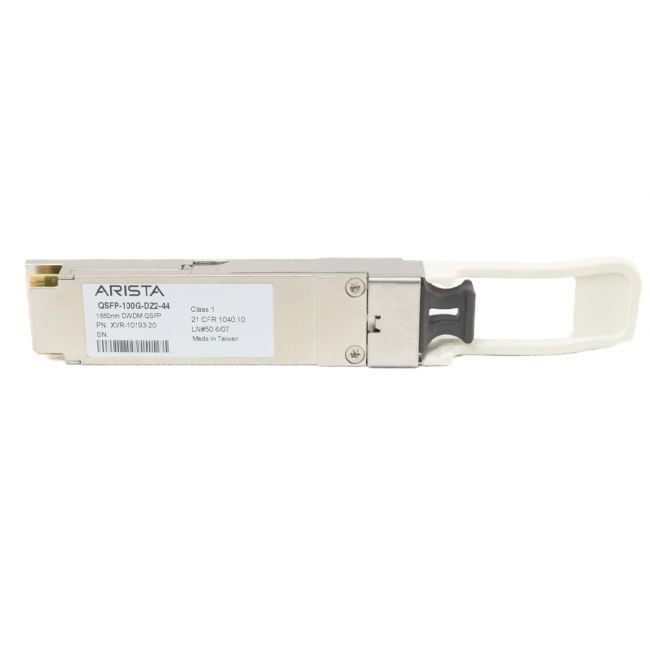
The Arista QSFP-100G-DZ2-44 offers 100G DWDM transceiver functionality designed for reliable high-speed networking across long distances. It fits into QSFP ports on Arista hardware and helps extend network reach efficiently using wavelength multiplexing on single-mode fiber. |
General Information |
|
|---|---|
| Brand | Arista Networks |
| Part Number | QSFP-100G-DZ2-44 |
Technical Information |
|
|---|---|
| Form Factor | QSFP28 |
| Media | SMF |
| Type | DFB |
| Protocols | 100G DWDM |
| Connector | LC Duplex |
| DOM Support | Yes |
Physical Characteristics |
|
|---|---|
| Weight | 5.00 |
| Condition | Refurbished |
Product Description |
|---|
The Arista QSFP-100G-DZ2-44 is built for long-distance, high-bandwidth network connections using DWDM technology. It enables 100 Gigabit Ethernet links over existing fiber infrastructures by sending multiple wavelengths on the same fiber strand. Often found in data centers and enterprise networks, this transceiver supports critical applications requiring reliable, high-speed connectivity over extended distances. Network engineers and operators benefit from its compatibility and efficient fiber utilization. Key Features
This transceiver is typically deployed in data centers connecting distant racks or sites without needing additional fiber cabling. It plays a key role in scaling network capacity while optimizing fiber infrastructure use. |
Use Cases |
|---|
The Arista QSFP-100G-DZ2-44 transceiver is suited for network environments that require high-capacity data transfer over extended distances. It is ideal for enterprises and service providers managing long-haul single-mode fiber links where bandwidth and efficiency are critical, such as in data centers and metropolitan area networks. How It's Used:
This transceiver enhances network scalability and operational efficiency by enabling dense wavelength multiplexing on existing fiber infrastructure. The extended 80 km reach supports flexible network design while maintaining consistent 100G performance critical for demanding enterprise and service provider workloads. |
 Shipping Options
 International Delivery
Requires a UPS, FedEx, or DHL account. Customers may arrange pickup from our US warehouse.
International Delivery
Requires a UPS, FedEx, or DHL account. Customers may arrange pickup from our US warehouse.
 Payment Methods
We accept Visa, Mastercard, AMEX, Discover, and Wire Transfer.
Payment Methods
We accept Visa, Mastercard, AMEX, Discover, and Wire Transfer.
 Purchase Orders
We process purchase orders for government agencies, enterprises, data centers, and SMBs.
Purchase Orders
We process purchase orders for government agencies, enterprises, data centers, and SMBs.