

Subscribe To Our Newsletter!
Subscribe to the newsletter to stay up to date with the latest news and most useful
Newsletter
↑
Back to Top



Product Overview |
|---|
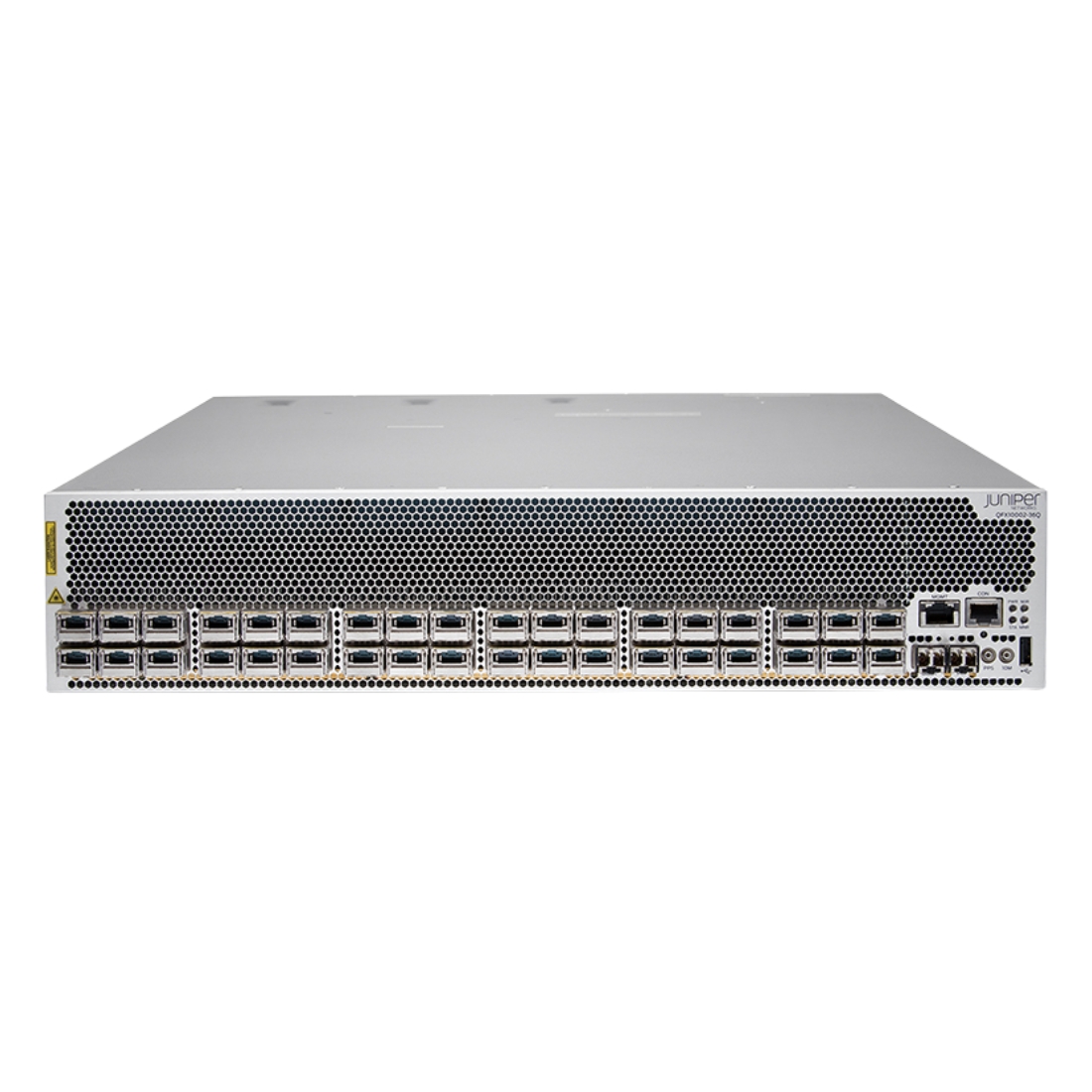
The Juniper QFX10002-36Q is a compact, high-capacity network switch that fits into standard racks while providing 40GbE connections. It’s typically used in data centers to handle routing and switching tasks with efficiency and reliability, making it a solid choice for environments requiring dense, managed network hardware. |
General Information |
|
|---|---|
| Brand | Juniper Networks |
| Part Number | QFX10002-36Q |
| Condition | Refurbished |
Technical Information |
|
|---|---|
| Switch Ports | 36 |
| Number of Ports | 36-Ports |
| Port Speed | 40GbE,10GbE |
| Switching Capacity | 2.88 Tbps |
| Switch Forwarding Rate | 4,285.7 Mpps |
| Max VLANs Supported | 1-4094 |
| Connector Type | QSFP+ (40GbE) |
Performance |
|
|---|---|
| Jumbo Frame Support | Up To 9216 Bytes |
Management and Configuration |
|
|---|---|
| Management Type | Junos CLI,Web GUI (J-Web),SNMP,SSH,NETCONF |
| Security | Access Control Lists (ACL),802.1X |
| Remote Management Protocol | SNMP,SSH,NETCONF |
| Routing Protocol | BGP,OSPF,IS-IS,RIP,Static Routing,VRRP |
Physical Characteristics |
|
|---|---|
| Weight | 3.00 |
| Operating Temperature | 0°C to 40°C (32°F to 104°F) |
Miscellaneous |
|
|---|---|
| Eco Friendly | Yes |
| Assembly Required | Yes |
| Compliance Standards | RoHS, CE, FCC, UL |
| Compliant Standards | IEEE 802.3,IEEE 802.3ba,IEEE 802.1Q,IEEE 802.1p,IEEE 802.1X |
Product Description |
|---|
The Juniper QFX10002-36Q is designed to deliver high-density 40GbE connectivity in a compact 2U form factor. Built for data centers and enterprise networks, it supports advanced Layer 3 routing to handle complex traffic flows efficiently. Network engineers and IT teams often rely on this switch to improve scalability and maintain robust network operations. Key Features
This switch is commonly found in large-scale data centers and cloud environments where space and performance are critical. It helps streamline network architecture, enabling smoother data flow and reducing bottlenecks in busy networks. |
Use Cases |
|---|
The Juniper QFX10002-36Q is predominantly deployed in high-density data center environments where 40GbE connectivity and Layer 3 routing capabilities are critical. Enterprises and service providers that demand scalable and reliable network infrastructure to support virtualization, storage, and cloud workloads benefit most from this switch. How It's Used:
This switch enhances operational efficiency by consolidating high-speed interfaces into a compact 2U form factor while delivering resilient, managed Layer 3 services. Its design supports scalability and performance in environments where network reliability and throughput are pivotal. |
 Shipping Options
 International Delivery
Requires a UPS, FedEx, or DHL account. Customers may arrange pickup from our US warehouse.
International Delivery
Requires a UPS, FedEx, or DHL account. Customers may arrange pickup from our US warehouse.
 Payment Methods
We accept Visa, Mastercard, AMEX, Discover, and Wire Transfer.
Payment Methods
We accept Visa, Mastercard, AMEX, Discover, and Wire Transfer.
 Purchase Orders
We process purchase orders for government agencies, enterprises, data centers, and SMBs.
Purchase Orders
We process purchase orders for government agencies, enterprises, data centers, and SMBs.