

Subscribe To Our Newsletter!
Subscribe to the newsletter to stay up to date with the latest news and most useful
Newsletter
↑
Back to Top



Product Overview |
|---|
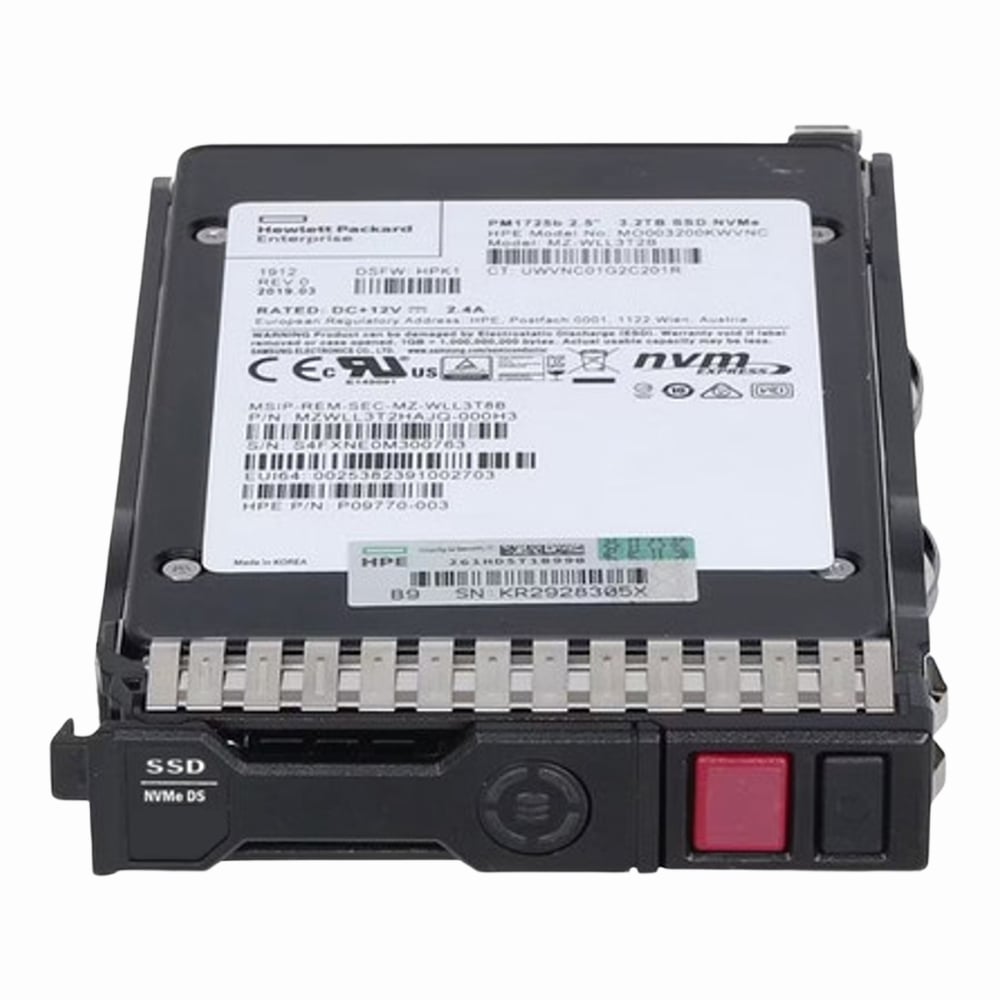
The HP 1.92TB Triple-Level Cell PCIe NVMe 4.0 x4 U.3 SSD is designed to provide reliable and speedy access to large volumes of data, especially in read-heavy scenarios. Its 2.5-inch form factor fits neatly into enterprise server environments, and the PCIe 4.0 interface ensures data flows quickly between the drive and the host system. This drive fits well in setups where consistent read performance is important and storage capacity needs to be high without adding unnecessary overhead. |
General Information |
|
|---|---|
| Brand | HP |
| Part Number | P50951-001 |
Technical Information |
|
|---|---|
| Capacity | 1.92TB |
| NAND Flash | Triple-Level Cell (TLC) |
| Memory Technology | Triple-Level Cell (TLC) |
| Form Factor | U.3 |
| Interface | PCIe Gen 4.0 x4 |
| Hot Swappable | Yes |
| Hot Pluggable | Yes |
Physical Characteristics |
|
|---|---|
| Weight | 1.10 |
| Condition | Refurbished |
Product Description |
|---|
This HP 1.92TB Triple-Level Cell PCIe NVMe 4.0 solid-state drive is built for environments that demand fast, reliable access to large data sets. It’s often found in data centers and enterprise servers where read-intensive tasks like database querying, virtualization, and content delivery are common. IT professionals and system administrators rely on drives like this to balance capacity with consistent performance. The U.3 2.5-inch form factor ensures compatibility with many server setups and storage arrays, making it a flexible option for scaling storage infrastructure without sacrificing speed. Its NVMe interface takes advantage of PCIe 4.0 lanes to maximize throughput and lower latency compared to older generation drives. Key Features
This drive is typically deployed in data centers handling large-scale read-heavy applications or cloud services. It plays a key role in reducing data bottlenecks and improving responsiveness in systems that require rapid access to stored information. By choosing this SSD, organizations can improve the efficiency of their storage infrastructure while keeping costs manageable, especially when write endurance is not the primary concern. |
Use Cases |
|---|
The HP 1.92TB TLC PCIe 4.0 x4 NVMe U.3 2.5-inch SSD is primarily suited for enterprise and data center environments where high-capacity, read-intensive storage is critical. IT administrators and infrastructure teams benefit from its optimized form factor and interface compatibility, enabling seamless integration into modern server racks and storage arrays. How It's Used:
This SSD helps maintain operational efficiency in demanding IT ecosystems by delivering scalable storage capacity with steady read performance. Its PCIe 4.0 interface and U.3 compatibility ensure compatibility with evolving server technologies while minimizing bottlenecks in data access workflows. |
 Shipping Options
 International Delivery
Requires a UPS, FedEx, or DHL account. Customers may arrange pickup from our US warehouse.
International Delivery
Requires a UPS, FedEx, or DHL account. Customers may arrange pickup from our US warehouse.
 Payment Methods
We accept Visa, Mastercard, AMEX, Discover, and Wire Transfer.
Payment Methods
We accept Visa, Mastercard, AMEX, Discover, and Wire Transfer.
 Purchase Orders
We process purchase orders for government agencies, enterprises, data centers, and SMBs.
Purchase Orders
We process purchase orders for government agencies, enterprises, data centers, and SMBs.