

Subscribe To Our Newsletter!
Subscribe to the newsletter to stay up to date with the latest news and most useful
Newsletter
↑
Back to Top



Product Overview |
|---|
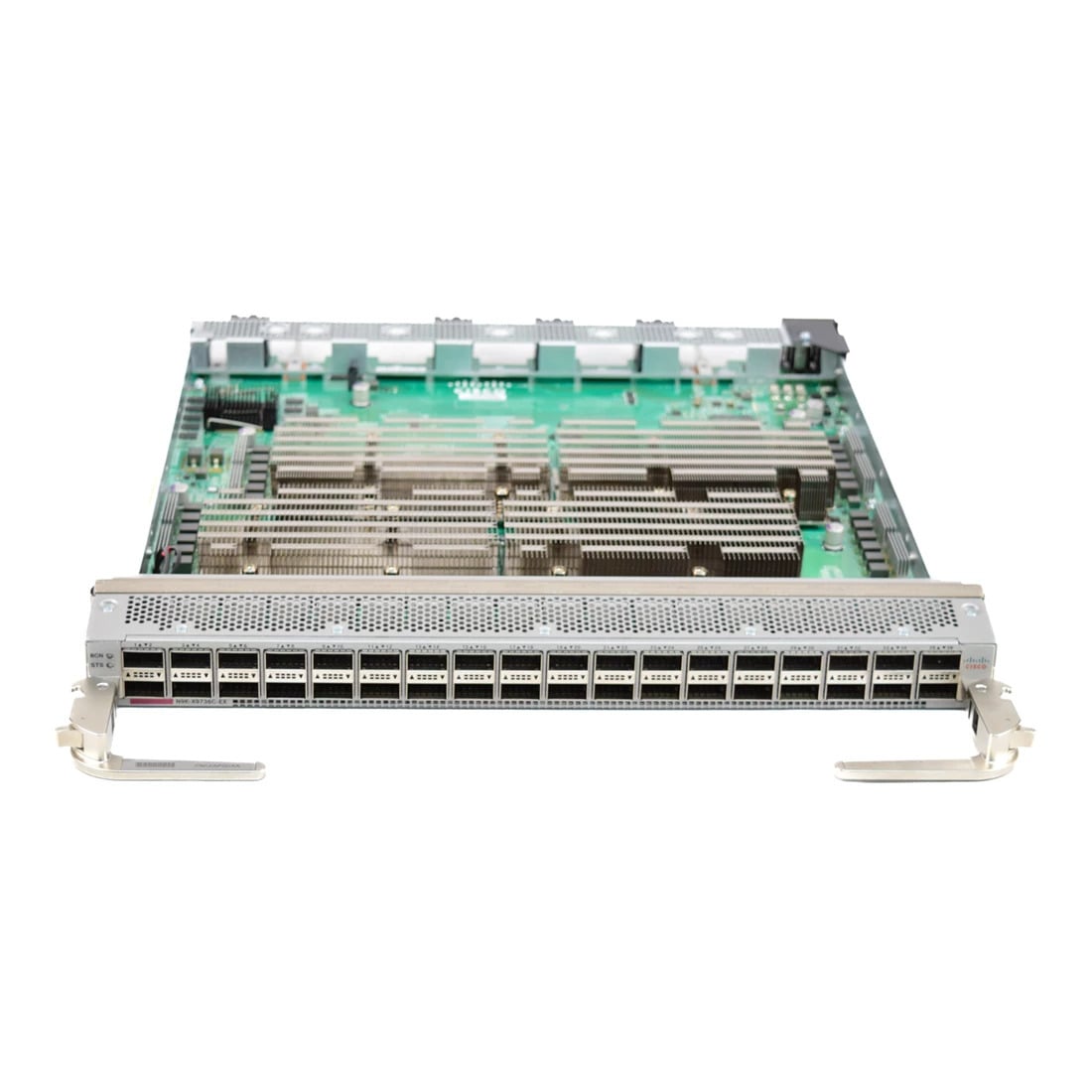
The Cisco Nexus N9K-X9736C-EX line card adds 36 ports of 100GbE connectivity to the Nexus 9500 chassis. It fits into data center aggregation or spine positions, providing high-density, high-speed links that support NX-OS software features. This card is designed for environments where reliable, scalable network performance is a priority without adding unnecessary complexity. |
General Information |
|
|---|---|
| Brand | Cisco |
| Part Number | N9K-X9736C-EX |
| Condition | Refurbished |
Technical Information |
|
|---|---|
| Switch Ports | 36 x 100GbE QSFP28 |
| Number of Ports | 36-Ports |
| Port Type | 25G SFP28, 100G QSFP28 |
| Port Speed | 100GbE |
| POE Support | No |
| VLAN Support | Yes |
| Max VLANs Supported | 1-4094 |
| Stackable | No |
| Layer Support | Layer 3 |
| Connector Type | QSFP28 |
Performance |
|
|---|---|
| Jumbo Frame Support | Up To 9216 Bytes |
Management and Configuration |
|
|---|---|
| Routing Protocols | Static, RIP, RIPng, OSPF, OSPFv3, EIGRP, BGP, IS-IS, VRRP, HSRP, GLBP, PIM-SM, PIM-DM, IGMP, MLD, Policy-Based Routing (PBR), Route Maps |
| Remote Protocols | Cisco NX-OS,CLI,SSH,Telnet,SNMP,NX-API |
| Routing Protocol | Layer 3 forwarding (provided by chassis NX-OS supervisors) |
Physical Characteristics |
|
|---|---|
| Weight | 5.00 |
Miscellaneous |
|
|---|---|
| Compliance Standards | RoHS, CE, FCC, UL |
Product Description |
|---|
This line card boosts network capacity by providing 36 high-speed 100GbE ports using QSFP28 interfaces. Built for the Cisco Nexus 9500 Series, it fits into enterprise and data center environments that require scalable and reliable aggregation or spine layer connectivity. Often found in large-scale data centers, this card simplifies network design by consolidating multiple high-bandwidth connections into a single module. Network engineers and architects typically use it to optimize traffic flow and reduce latency in complex topologies. Key Features
You'll usually see this line card deployed in core data center networks where large volumes of data move between aggregation and spine layers. Its role in simplifying cabling and enhancing bandwidth makes it a practical choice for keeping up with growing network demands. |
 Shipping Options
 International Delivery
Requires a UPS, FedEx, or DHL account. Customers may arrange pickup from our US warehouse.
International Delivery
Requires a UPS, FedEx, or DHL account. Customers may arrange pickup from our US warehouse.
 Payment Methods
We accept Visa, Mastercard, AMEX, Discover, and Wire Transfer.
Payment Methods
We accept Visa, Mastercard, AMEX, Discover, and Wire Transfer.
 Purchase Orders
We process purchase orders for government agencies, enterprises, data centers, and SMBs.
Purchase Orders
We process purchase orders for government agencies, enterprises, data centers, and SMBs.