

Subscribe To Our Newsletter!
Subscribe to the newsletter to stay up to date with the latest news and most useful
Newsletter
↑
Back to Top



Product Overview |
|---|
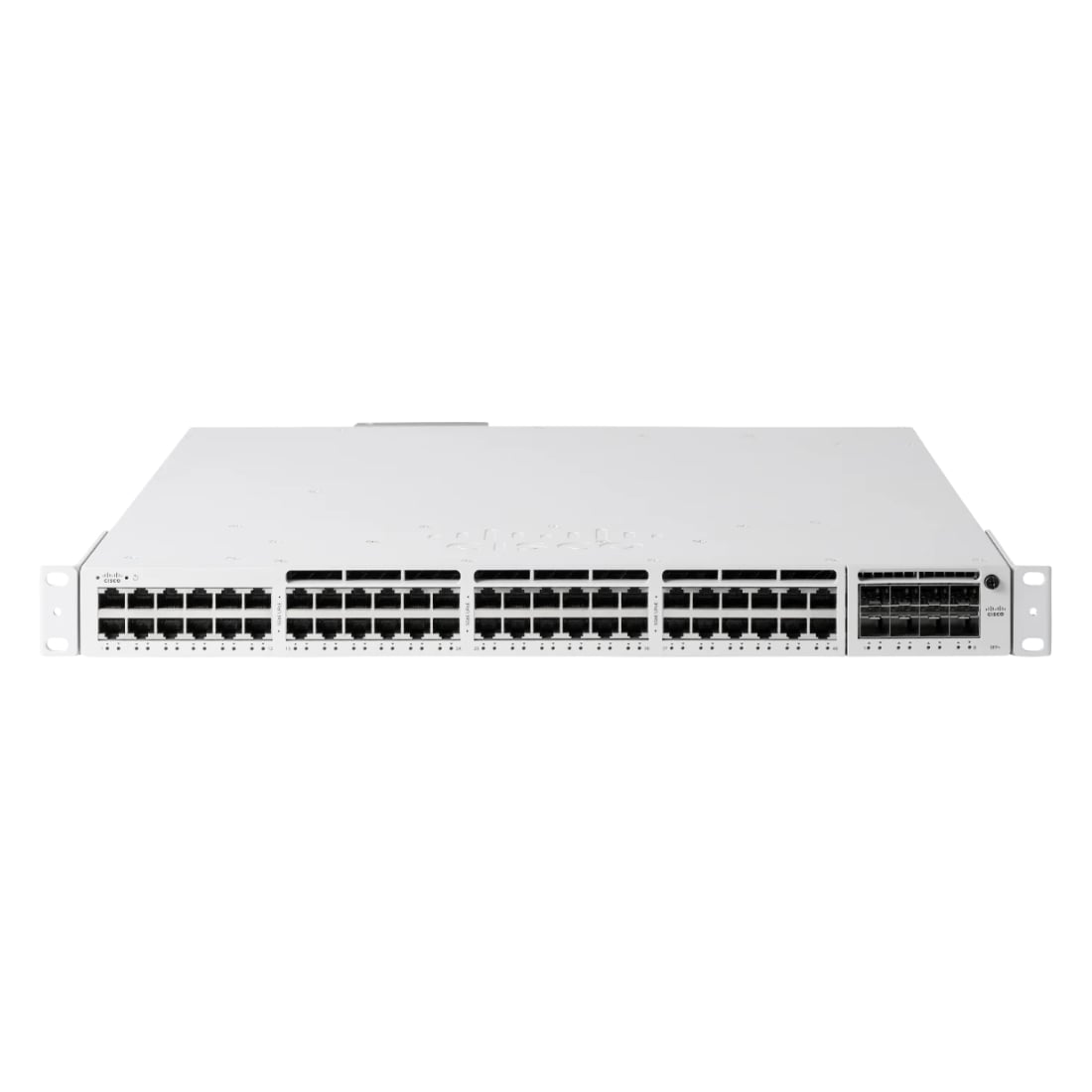
The Cisco Meraki MS390-48UX2 switch delivers versatile, multi-gigabit connectivity combined with robust Layer 3 capabilities and UPoE support. It fits into enterprise or campus networks that need flexible power options alongside reliable data handling, simplifying the setup and management of complex network environments. |
General Information |
|
|---|---|
| Brand | Cisco |
| Part Number | MS390-48UX2 |
| Condition | Refurbished |
Technical Information |
|
|---|---|
| Switch Ports | 48 |
| Number of Ports | 48-Ports |
| Port Speed | 100 Mbps,1 Gbps,2.5 Gbps,5 Gbps,10 Gbps |
| Max VLANs Supported | 1-4094 |
| Connector Type | RJ45,SFP+,QSFP+ |
Performance |
|
|---|---|
| Jumbo Frame Support | Up To 9216 Bytes |
Management and Configuration |
|
|---|---|
| Security | 802.1X,RADIUS,ACLs |
| Remote Management Protocol | Meraki Cloud Dashboard (HTTPS), SNMP, REST API, Syslog |
| Routing Protocol | Static Routing, OSPF, BGP |
Physical Characteristics |
|
|---|---|
| Weight | 3.00 |
Miscellaneous |
|
|---|---|
| Compliance Standards | RoHS, CE, FCC, UL |
| Compliant Standards | IEEE 802.3, IEEE 802.3u, IEEE 802.3ab, IEEE 802.3bz, IEEE 802.1Q, IEEE 802.1p, IEEE 802.1X, IEEE 802.3af, IEEE 802.3at, IEEE 802.3bt |
Product Description |
|---|
The Cisco Meraki MS390-48UX2 is a high-performance Layer 3 switch built for environments needing fast, reliable, and flexible network connections. It’s commonly found in campus networks, data centers, and enterprise setups where multi-gigabit speeds and power over Ethernet are essential. Network administrators and IT teams often rely on the MS390-48UX2 to simplify complex network demands while providing scalability and security. Its UPoE feature allows connected devices like IP cameras, wireless access points, and other power-hungry equipment to run without additional power sources. Key Features
This switch is typically deployed in organizations that require a combination of speed, power, and control across multiple devices. Its role often extends to powering devices directly while handling demanding network loads, making it a practical choice for modern wired infrastructure. |
 Shipping Options
 International Delivery
Requires a UPS, FedEx, or DHL account. Customers may arrange pickup from our US warehouse.
International Delivery
Requires a UPS, FedEx, or DHL account. Customers may arrange pickup from our US warehouse.
 Payment Methods
We accept Visa, Mastercard, AMEX, Discover, and Wire Transfer.
Payment Methods
We accept Visa, Mastercard, AMEX, Discover, and Wire Transfer.
 Purchase Orders
We process purchase orders for government agencies, enterprises, data centers, and SMBs.
Purchase Orders
We process purchase orders for government agencies, enterprises, data centers, and SMBs.