

Subscribe To Our Newsletter!
Subscribe to the newsletter to stay up to date with the latest news and most useful
Newsletter
↑
Back to Top



Product Overview |
|---|
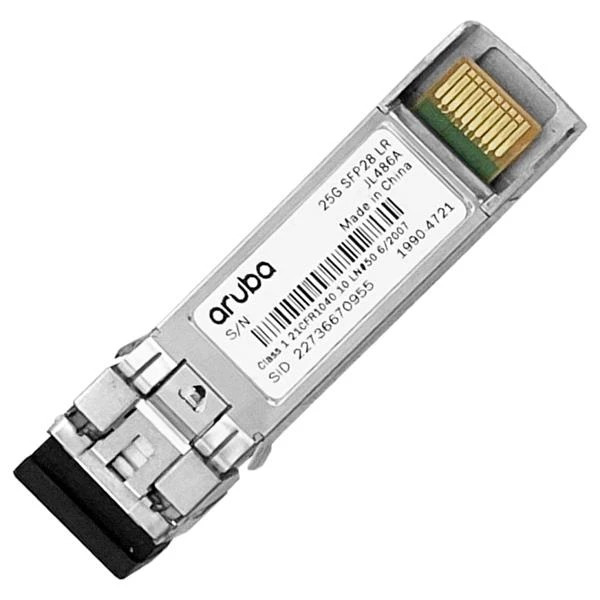
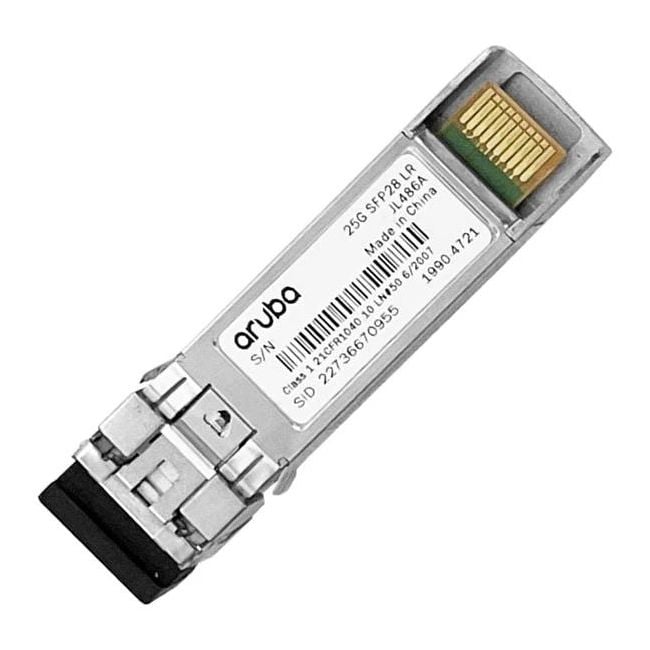
The HPE JL486A Aruba 25G SFP28 LC LR transceiver is designed to deliver reliable 25Gbps connectivity over long distances using single-mode fiber. It fits into network setups requiring extended reach without compromising performance, commonly seen in enterprise and data center environments. |
General Information |
|
|---|---|
| Brand | HPE |
| Part Number | JL486A |
Technical Information |
|
|---|---|
| Form Factor | SFP28 |
| Media | SMF |
| Type | DFB |
| Power Consumption | ≤1.5 W |
| Protocols | 25GBASE-LR (IEEE 802.3by),25GbE |
| Connector | LC Duplex |
| DOM Support | Yes |
Physical Characteristics |
|
|---|---|
| Weight | 5.00 |
| Condition | Refurbished |
Product Description |
|---|
This transceiver module enables 25G data transmission over single-mode fiber for reliable long-distance connectivity. It's commonly used in data centers, enterprise networks, and service provider environments where high-speed and stable links are essential. Built for network engineers and IT professionals managing Aruba or HPE infrastructure, it helps maintain seamless communication between switches and servers across extended distances. Key Features
This transceiver is often deployed in campus backbones and data center interconnects where distance and speed matter. It facilitates smooth data flow with minimal latency, supporting critical network functions without disruption. |
Use Cases |
|---|
The HPE Aruba 25G SFP28 LC LR transceiver is primarily utilized in enterprise and data center environments where high-speed, long-distance network connectivity is essential. It is suitable for IT professionals managing infrastructure that demands reliable 25Gbps links across extended single-mode fiber runs, ensuring minimal latency and sustained throughput. How It's Used:
By enabling consistent high-speed data transmission over distances up to 10 kilometers, this transceiver enhances network scalability and operational efficiency. It supports the deployment of robust, future-proof network architectures capable of handling evolving enterprise workloads and bandwidth demands. |
 Shipping Options
 International Delivery
Requires a UPS, FedEx, or DHL account. Customers may arrange pickup from our US warehouse.
International Delivery
Requires a UPS, FedEx, or DHL account. Customers may arrange pickup from our US warehouse.
 Payment Methods
We accept Visa, Mastercard, AMEX, Discover, and Wire Transfer.
Payment Methods
We accept Visa, Mastercard, AMEX, Discover, and Wire Transfer.
 Purchase Orders
We process purchase orders for government agencies, enterprises, data centers, and SMBs.
Purchase Orders
We process purchase orders for government agencies, enterprises, data centers, and SMBs.