

Subscribe To Our Newsletter!
Subscribe to the newsletter to stay up to date with the latest news and most useful
Newsletter
↑
Back to Top



Product Overview |
|---|
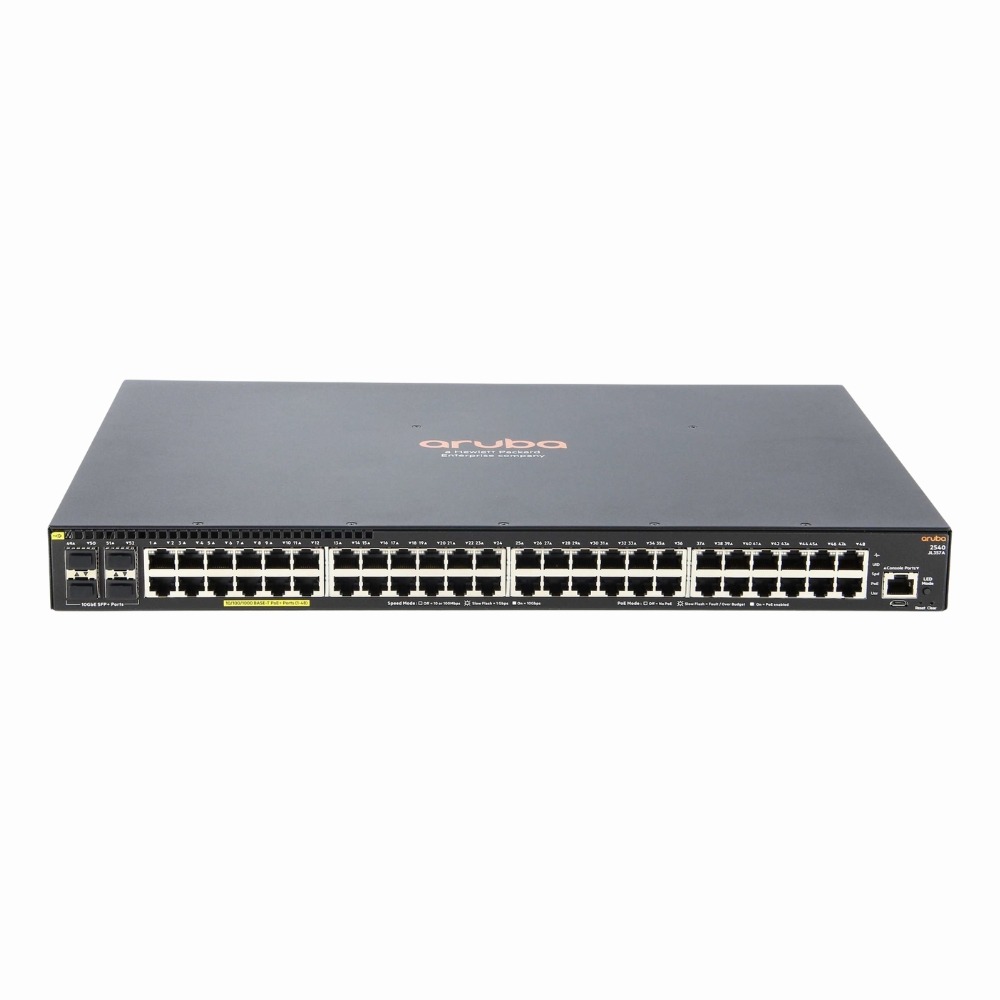
The HP Aruba 2540 Series 2540 48G 4SFP+ switch is a Layer 2 managed device designed to provide reliable gigabit connectivity for enterprise networks. Featuring 48 RJ-45 ports alongside four 10Gbps SFP+ slots, it fits well into access layer roles where flexibility and network control are important. |
General Information |
|
|---|---|
| Brand | HPE |
| Part Number | JL355-61101 |
| Condition | Refurbished |
Technical Information |
|
|---|---|
| Switch Ports | 48 |
| Number of Ports | 52-Ports |
| Port Type | 10/100/1000Base-T, 10G SFP+ |
| Port Speed | 10/100/1000 Mbps,10 Gbps |
| UpLink Ports | 4 x SFP+ |
| POE Support | No |
| Switching Capacity | 176 Gbps |
| Switch Forwarding Rate | 343.75 Mpps |
| VLAN Support | Yes |
| Max VLANs Supported | 1-4094 |
| Layer Support | Layer 2, Layer 3 Lite |
| Connector Type | RJ-45,SFP+ |
Performance |
|
|---|---|
| Jumbo Frame Support | Up To 9216 Bytes |
Management and Configuration |
|
|---|---|
| Routing Protocols | Static, RIP |
| Remote Protocols | Web GUI,CLI (SSH/Telnet),SNMP,Aruba Central,AirWave |
| Management Interfaces | USB Console,Serial Console (RJ-45),Web GUI,SSH |
| Security Features | 802.1X,ACLs,MAC Authentication,Port Security,DHCP Snooping,Storm Control,BPDU Guard |
| Remote Management Protocol | SNMPv1/v2c/v3,HTTP/HTTPS,SSH,Telnet |
| Routing Protocol | Static,RIP |
Physical Characteristics |
|
|---|---|
| Weight | 5.00 |
| Operating Temperature | 0°C to 45°C |
Miscellaneous |
|
|---|---|
| Eco Friendly | Yes |
| Compliance Standards | WEEE, RoHS, CE, FCC, UL, TUV, cULus |
| Compliant Standards | IEEE 802.3, IEEE 802.3u, IEEE 802.3ab, IEEE 802.3ae, IEEE 802.1Q, IEEE 802.1p, IEEE 802.1X, IEEE 802.3ad (LACP), IEEE 802.3x |
Product Description |
|---|
This HP Aruba 2540 Series switch is built for reliable and efficient network access, often found in medium to large enterprise environments. It delivers essential Layer 2 capabilities such as VLAN segmentation, link aggregation, and quality of service to optimize traffic flow across the network. Network administrators commonly use this switch to manage wired devices like computers, printers, and IP phones, ensuring stable connections with minimal downtime. Key Features
Typically deployed in office wiring closets or data center access layers, this switch handles heavy networking demands with ease. Its versatility allows it to support a wide range of applications from everyday connectivity to VoIP and video conferencing, helping maintain smooth and efficient network performance. |
Use Cases |
|---|
The HP Aruba 2540 48G 4SFP+ switch is engineered for enterprise access layer deployments that require robust, managed gigabit connectivity with scalable uplink options. It is well suited for mid-sized to large office environments, campus networks, and branch locations where centralized network control and performance consistency are critical. How It's Used:
By integrating 48 gigabit ports with 10Gbps SFP+ uplink flexibility, the switch enables efficient traffic distribution and segmentation while maintaining operational simplicity. Its Layer 2 management capabilities help optimize network performance and scalability in environments that demand controlled access and reliable throughput. |
 Shipping Options
 International Delivery
Requires a UPS, FedEx, or DHL account. Customers may arrange pickup from our US warehouse.
International Delivery
Requires a UPS, FedEx, or DHL account. Customers may arrange pickup from our US warehouse.
 Payment Methods
We accept Visa, Mastercard, AMEX, Discover, and Wire Transfer.
Payment Methods
We accept Visa, Mastercard, AMEX, Discover, and Wire Transfer.
 Purchase Orders
We process purchase orders for government agencies, enterprises, data centers, and SMBs.
Purchase Orders
We process purchase orders for government agencies, enterprises, data centers, and SMBs.