

Subscribe To Our Newsletter!
Subscribe to the newsletter to stay up to date with the latest news and most useful
Newsletter
↑
Back to Top



Product Overview |
|---|
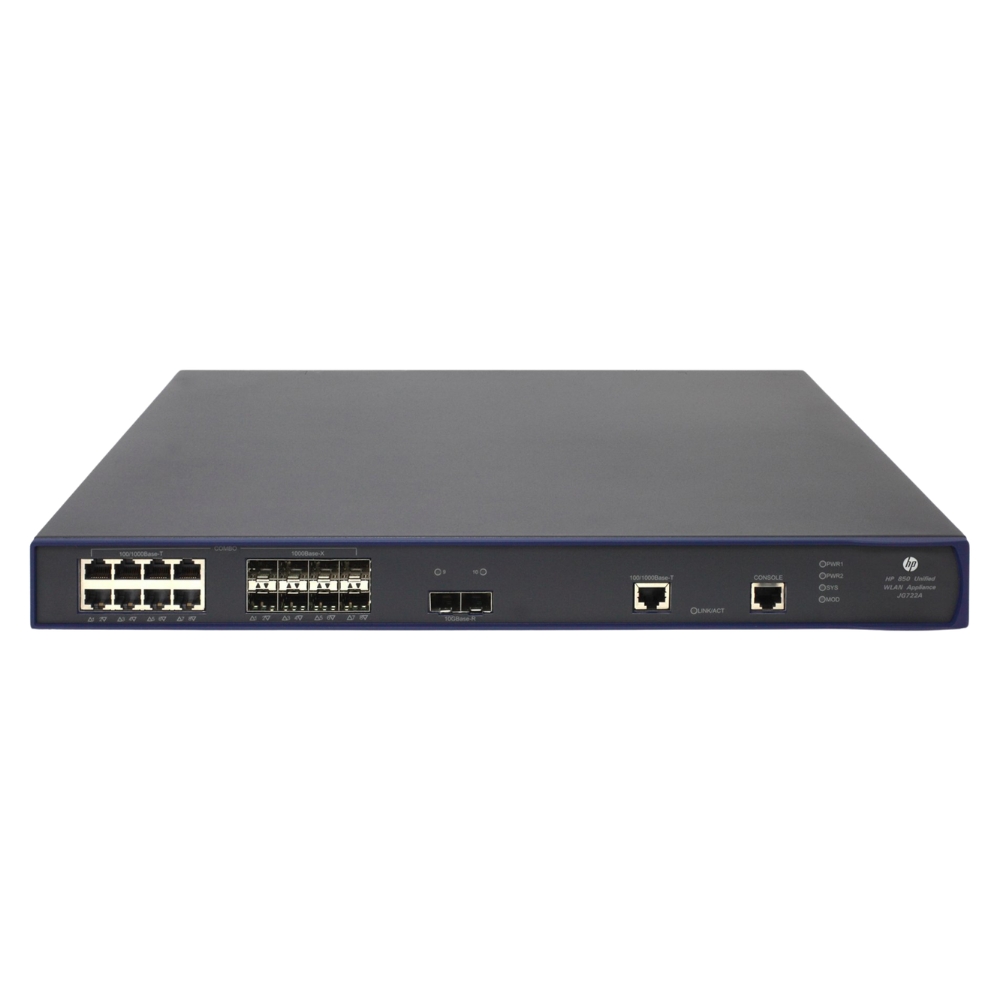
The JG722AR HP 850 Unified Wired-WLAN Controller manages both wired and wireless network components from a single platform. It fits in environments where unified network control is essential, balancing performance with security and scalability without adding unnecessary complexity. |
General Information |
|
|---|---|
| Brand | HP |
| Condition | Refurbished |
Technical Information |
|
|---|---|
| Port Type | 1000Base-T |
| Port Speed | 1000Base-T |
| POE Support | No |
| VLAN Support | Yes |
| Stackable | No |
Management and Configuration |
|
|---|---|
| Remote Protocols | Yes |
| Management Interfaces | Web UI,CLI,SSH,SNMP |
| Security Features | 802.1X,RADIUS,TACACS+ |
| Management Type | Centralized |
| Remote Management Protocol | HTTPS,SSH,SNMP |
Physical Characteristics |
|
|---|---|
| Weight | 3.00 |
Product Description |
|---|
The JG722AR HP 850 Unified Wired-WLAN Controller is built to streamline and simplify network management by unifying control over both wired and wireless infrastructures. Often found in enterprise and campus environments, it helps network administrators handle complex network setups with greater ease. This controller is typically utilized by IT professionals who require centralized control and robust network security. Key Features
Its role is to maintain reliable network performance while simplifying administrative tasks. Through consistent monitoring and control, the controller ensures network stability and supports growing connectivity demands efficiently. |
Use Cases |
|---|
The JG722AR controller is commonly deployed in medium to large enterprise networks where centralized management of wired and wireless systems is critical. It benefits organizations requiring secure, scalable connectivity across multiple locations or departments. How It's Used:
This controller helps maintain operational efficiency by consolidating network management tasks, improving visibility, and ensuring robust performance even as network demands evolve. |
 Shipping Options
 International Delivery
Requires a UPS, FedEx, or DHL account. Customers may arrange pickup from our US warehouse.
International Delivery
Requires a UPS, FedEx, or DHL account. Customers may arrange pickup from our US warehouse.
 Payment Methods
We accept Visa, Mastercard, AMEX, Discover, and Wire Transfer.
Payment Methods
We accept Visa, Mastercard, AMEX, Discover, and Wire Transfer.
 Purchase Orders
We process purchase orders for government agencies, enterprises, data centers, and SMBs.
Purchase Orders
We process purchase orders for government agencies, enterprises, data centers, and SMBs.