

Subscribe To Our Newsletter!
Subscribe to the newsletter to stay up to date with the latest news and most useful
Newsletter
↑
Back to Top



Product Overview |
|---|
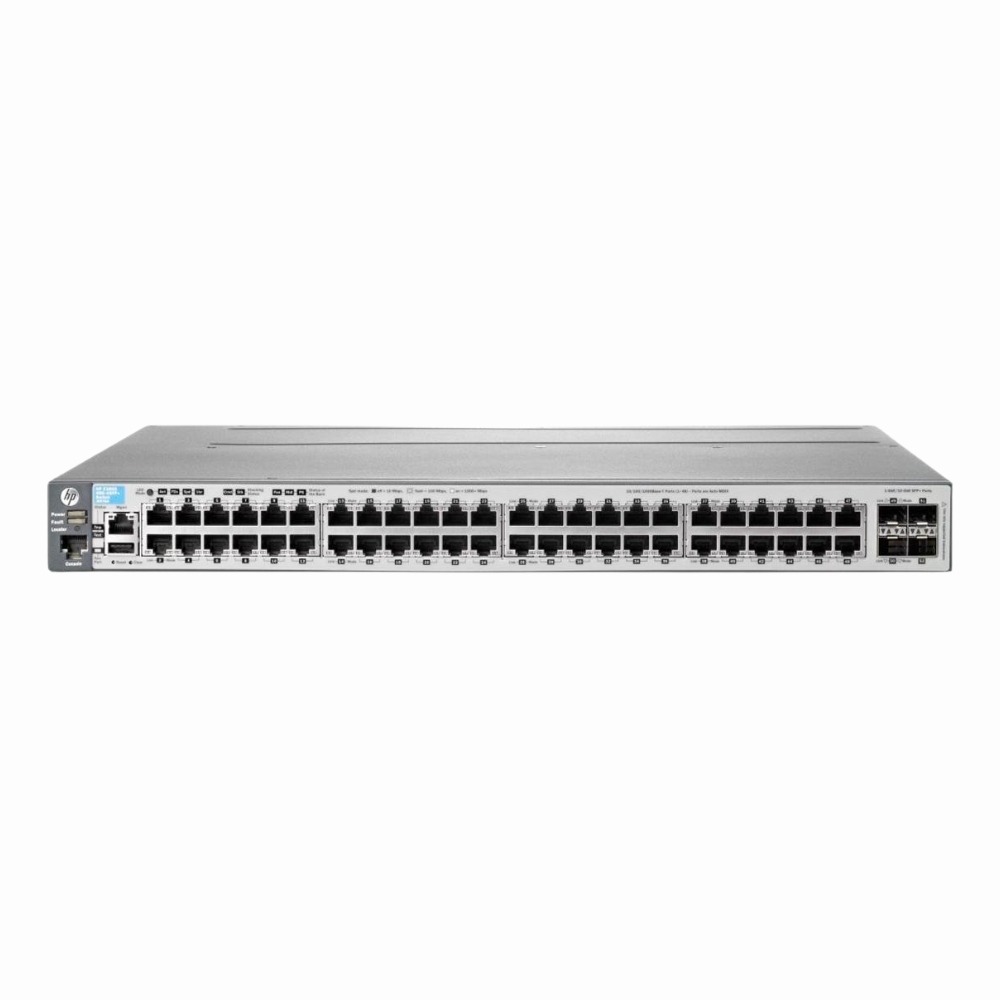
The HP E3800 Series 3800-48G-4XG is a managed network switch designed to provide 48 Gigabit Ethernet ports along with 4 SFP+ slots for enhanced connectivity. It fits well into business networks that need a balance of high port density and advanced traffic management, often serving as a core or aggregation switch in medium to large environments. |
General Information |
|
|---|---|
| Brand | HP |
| Part Number | J9586A |
| Condition | Refurbished |
Technical Information |
|
|---|---|
| Switch Ports | 48 |
| Number of Ports | 48-Ports |
| Port Type | 10/100/1000Base-T, 10G SFP+ |
| Port Speed | 10/100/1000Base-T,10G SFP+ |
| UpLink Ports | 4 |
| POE Support | No |
| Switching Capacity | 176 Gbps |
| Switch Forwarding Rate | 343750000 pps |
| VLAN Support | Yes |
| Max VLANs Supported | 1-4094 |
| Layer Support | Layer 4 |
| Connector Type | RJ-45,SFP+ |
Performance |
|
|---|---|
| Jumbo Frame Support | Up To 9216 Bytes |
Management and Configuration |
|
|---|---|
| Remote Protocols | Yes |
| Management Interfaces | Web GUI (HTTP/HTTPS),Serial Console (RJ-45),SSH,Telnet,SNMP |
| Security Features | IEEE 802.1X,Access Control Lists (ACLs),SSH,RADIUS,TACACS+,Storm control |
| Remote Management Protocol | SNMPv1/v2c/v3,HTTP/HTTPS,SSH,Telnet |
Physical Characteristics |
|
|---|---|
| Weight | 5.00 |
Miscellaneous |
|
|---|---|
| Compliance Standards | RoHS, CE, FCC, UL |
| Compliant Standards | IEEE 802.3, IEEE 802.3u, IEEE 802.3ab, IEEE 802.3x, IEEE 802.1Q, IEEE 802.1p, IEEE 802.1D |
Product Description |
|---|
The HP E3800 Series 3800-48G-4XG switch is built for medium to large networks needing reliable, high-speed connectivity. It’s often found in corporate data centers and campus environments where managing multiple devices and traffic types efficiently is crucial. Network administrators and IT teams benefit from its robust layer 4 features, which provide more granular control over network traffic compared to simpler switches. Key Features
This switch typically sits in core or distribution layers of network setups, handling everything from user workstations to servers and wireless access points. Its flexibility and management features make it a practical choice for organizations that require tailored network performance and reliability without overly complex infrastructure. |
 Shipping Options
 International Delivery
Requires a UPS, FedEx, or DHL account. Customers may arrange pickup from our US warehouse.
International Delivery
Requires a UPS, FedEx, or DHL account. Customers may arrange pickup from our US warehouse.
 Payment Methods
We accept Visa, Mastercard, AMEX, Discover, and Wire Transfer.
Payment Methods
We accept Visa, Mastercard, AMEX, Discover, and Wire Transfer.
 Purchase Orders
We process purchase orders for government agencies, enterprises, data centers, and SMBs.
Purchase Orders
We process purchase orders for government agencies, enterprises, data centers, and SMBs.