Subscribe To Our Newsletter!
Subscribe to the newsletter to stay up to date with the latest news and most useful
Newsletter
↑
Back to Top



Product Overview |
|---|
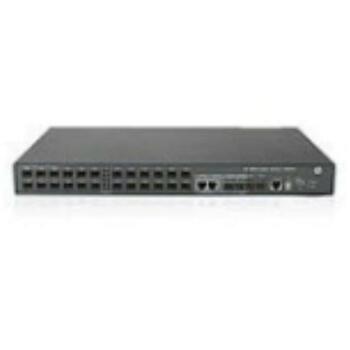
The HP 3600-24-SFP V2 EI switch manages fiber and copper connections within enterprise environments, combining 24 fiber ports with additional Gigabit and shared RJ-45 interfaces. It fits well in server rooms needing reliable, manageable switching that supports detailed traffic handling at Layer 4. |
General Information |
|
|---|---|
| Brand | HP |
| Condition | Refurbished |
Technical Information |
|
|---|---|
| Switch Ports | 24 x 100 Mbit SFP |
| Number of Ports | 24-Ports |
| Port Type | 10/100/1000Base-T, 1000Base-X, Combo RJ-45/SFP, SFP, USB Console, Serial Console (RJ-45) |
| Port Speed | 100 Mbit,1000 Mbit |
| UpLink Ports | 4 x Gigabit SFP,2 x Shared 10/100/1000 (Combo) |
| POE Support | No |
| VLAN Support | Yes |
| Max VLANs Supported | 4094 |
| Stackable | No |
| Layer Support | Layer 4 |
| Connector Type | SFP,Combo RJ-45/SFP,RJ-45,Serial Console (RJ-45),USB Console |
Performance |
|
|---|---|
| Jumbo Frame Support | Up To 9216 Bytes |
Management and Configuration |
|
|---|---|
| Routing Protocols | Static, RIP, IGMP |
| Remote Protocols | Yes |
| Management Interfaces | Web GUI (HTTP/HTTPS), CLI (SSH/Telnet), SNMP (v1/v2c/v3), RMON |
| Remote Management Protocol | SNMPv1,SNMPv2c,SNMPv3,HTTP,HTTPS,Telnet,SSH |
| Routing Protocol | Static,RIP |
Physical Characteristics |
|
|---|---|
| Weight | 3.00 |
Miscellaneous |
|
|---|---|
| Eco Friendly | Yes |
| Compliance Standards | WEEE, RoHS, CE, FCC, cULus |
| Compliant Standards | IEEE 802.3, IEEE 802.3u, IEEE 802.3ab, IEEE 802.1Q, IEEE 802.1p, IEEE 802.1D |
Product Description |
|---|
The HP 3600-24-SFP V2 EI switch provides reliable network connectivity with a focus on fiber optic deployment. It’s commonly used in enterprise networks where stable fiber switching is essential, often found in wiring closets or network racks. Built for network administrators and IT professionals, it allows effective management of data flow and prioritization at Layer 4, making it well-suited to environments where traffic shaping and security are important. Key Features
This switch is typically seen in mid-sized corporate networks or departments requiring dedicated fiber links with manageable traffic. Its role often involves handling backbone connections or aggregating multiple fiber segments with precise traffic control. |
Use Cases |
|---|
The HP 3600-24-SFP V2 EI switch is ideal for enterprise IT environments requiring robust fiber and copper connectivity for segmented network traffic. It is particularly suited for server rooms and data centers where managed Layer 4 switching supports complex network policies and traffic prioritization. How It's Used:
This switch enhances operational efficiency by delivering scalable fiber and copper integration while enabling advanced traffic management. It supports high-performance workloads and network segmentation necessary for evolving enterprise infrastructures. |
 Shipping Options
 International Delivery
Requires a UPS, FedEx, or DHL account. Customers may arrange pickup from our US warehouse.
International Delivery
Requires a UPS, FedEx, or DHL account. Customers may arrange pickup from our US warehouse.
 Payment Methods
We accept Visa, Mastercard, AMEX, Discover, and Wire Transfer.
Payment Methods
We accept Visa, Mastercard, AMEX, Discover, and Wire Transfer.
 Purchase Orders
We process purchase orders for government agencies, enterprises, data centers, and SMBs.
Purchase Orders
We process purchase orders for government agencies, enterprises, data centers, and SMBs.