

Subscribe To Our Newsletter!
Subscribe to the newsletter to stay up to date with the latest news and most useful
Newsletter
↑
Back to Top



Product Overview |
|---|
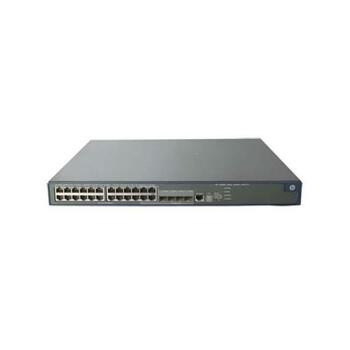
The HP A5500-24G-PoE switch combines 24 PoE-capable Gigabit ports with four SFP slots to offer versatile connectivity options. It fits into enterprise networks that need managed Layer 4 switching to handle complex traffic patterns and power devices on the same network cable. This model is a practical choice where both performance and power delivery are essential. |
General Information |
|
|---|---|
| Brand | HP |
| Condition | Refurbished |
Technical Information |
|
|---|---|
| Switch Ports | 24 |
| Number of Ports | 24-Ports |
| Port Type | 10/100/1000Base-T, Combo RJ-45/SFP, SFP, USB Console, Serial Console (RJ-45) |
| Port Speed | 10/100/1000 Mbps |
| UpLink Ports | 4 x SFP (shared) |
| POE Support | PoE |
| VLAN Support | Yes |
| Max VLANs Supported | 1-4094 |
| Layer Support | Layer 4 |
| Connector Type | RJ-45,SFP,Combo RJ-45/SFP,Serial Console (RJ-45),USB Console |
Management and Configuration |
|
|---|---|
| Remote Protocols | Yes |
| Management Interfaces | Web (HTTP/HTTPS),CLI (Console),SSH,Telnet,SNMP |
| Remote Management Protocol | SNMP,SSH,Telnet,HTTP,HTTPS |
Physical Characteristics |
|
|---|---|
| Weight | 3.00 |
Product Description |
|---|
The HP A5500-24G-PoE is a managed Gigabit Ethernet switch designed to handle demanding network environments. It provides 24 ports capable of 10/100/1000Base-T connections with Power over Ethernet, allowing devices like IP cameras or VoIP phones to receive power and data through a single cable. Often found in medium to large office networks, this switch improves network efficiency and security with advanced Layer 4 features. Network administrators and IT professionals commonly use it to optimize traffic and maintain reliable connectivity. Key Features
This switch is typically deployed in corporate environments, data centers, and network closets where reliable power and data transmission are critical. It plays a key role in supporting IP-based devices while managing bandwidth allocation effectively. |
Use Cases |
|---|
The HP 24-Port Gigabit PoE + 4 SFP Layer-4 Managed Ethernet Switch is well-suited for enterprise environments requiring advanced traffic management and reliable power delivery over network cables. It effectively supports complex network topologies where both high-speed connectivity and device powering are critical. How It's Used:
This switch enhances operational efficiency by consolidating data and power delivery while enabling granular traffic management. It offers scalability for growing network demands and ensures stable performance in environments where device uptime and bandwidth control are paramount. |
 Shipping Options
 International Delivery
Requires a UPS, FedEx, or DHL account. Customers may arrange pickup from our US warehouse.
International Delivery
Requires a UPS, FedEx, or DHL account. Customers may arrange pickup from our US warehouse.
 Payment Methods
We accept Visa, Mastercard, AMEX, Discover, and Wire Transfer.
Payment Methods
We accept Visa, Mastercard, AMEX, Discover, and Wire Transfer.
 Purchase Orders
We process purchase orders for government agencies, enterprises, data centers, and SMBs.
Purchase Orders
We process purchase orders for government agencies, enterprises, data centers, and SMBs.