Subscribe To Our Newsletter!
Subscribe to the newsletter to stay up to date with the latest news and most useful
Newsletter
↑
Back to Top



Product Overview |
|---|
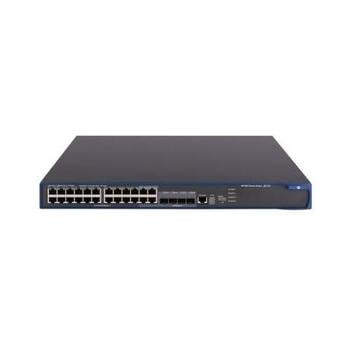
The HP 5500-24G is a versatile managed gigabit switch that combines 24 copper ports and 4 fiber SFP connections to serve as a flexible network backbone. It fits well in enterprise networks needing scalable performance and detailed traffic management without adding unnecessary complexity. |
General Information |
|
|---|---|
| Brand | HP |
| Condition | Refurbished |
Technical Information |
|
|---|---|
| Switch Ports | 24 |
| Number of Ports | 24-Ports |
| Port Type | 10/100/1000Base-T, SFP, USB Console, Serial Console (RJ-45) |
| Port Speed | 10/100/1000 Mbps |
| UpLink Ports | 4 x SFP (shared) |
| POE Support | No |
| VLAN Support | Yes |
| Max VLANs Supported | 1-4094 |
| Stackable | Yes |
| Layer Support | Layer 4 |
| Connector Type | RJ-45,SFP |
Performance |
|
|---|---|
| Jumbo Frame Support | Up To 9216 Bytes |
Management and Configuration |
|
|---|---|
| Remote Protocols | Yes |
| Management Interfaces | Web GUI,Command Line (CLI),SNMP |
| Security Features | Access Control Lists (ACLs),802.1X Authentication,DHCP Snooping,Storm Control,MAC Filtering |
| Remote Management Protocol | SNMP,Telnet,SSH,HTTP,HTTPS |
Physical Characteristics |
|
|---|---|
| Weight | 3.00 |
Product Description |
|---|
This HP 5500-24G switch is built to deliver reliable and fast wired connections across business networks. Often found in office environments and data centers, it handles core switching tasks with support for gigabit speeds on 24 copper ports, alongside 4 fiber uplink options. Designed for IT professionals and network administrators, the switch's Layer-4 management features enable fine-tuned control over traffic prioritization and security policies. Its stackable nature makes it ideal for growing networks, allowing multiple switches to operate as a single unit. Key Features
This switch is commonly deployed in medium to large enterprise setups, where dependable connectivity and network control are essential. Its role often involves aggregating multiple access switches or connecting servers and core infrastructure. Users benefit from its combination of speed, manageability, and expansion options, making it a solid choice for evolving network demands without frequent hardware replacements. |
Use Cases |
|---|
The HP 5500-24G switch is commonly deployed in mid-sized enterprise environments where high reliability and advanced traffic management are necessary. It benefits IT teams managing complex network segments requiring layered security and scalable port configurations, especially in settings with growing data demands and mixed media connections. How It's Used:
This switch facilitates operational efficiency by consolidating network management while offering scalable connectivity options. Its stackable design and traffic control capabilities allow IT administrators to tailor performance precisely, accommodating evolving infrastructure requirements without disruptive upgrades. |
 Shipping Options
 International Delivery
Requires a UPS, FedEx, or DHL account. Customers may arrange pickup from our US warehouse.
International Delivery
Requires a UPS, FedEx, or DHL account. Customers may arrange pickup from our US warehouse.
 Payment Methods
We accept Visa, Mastercard, AMEX, Discover, and Wire Transfer.
Payment Methods
We accept Visa, Mastercard, AMEX, Discover, and Wire Transfer.
 Purchase Orders
We process purchase orders for government agencies, enterprises, data centers, and SMBs.
Purchase Orders
We process purchase orders for government agencies, enterprises, data centers, and SMBs.