Subscribe To Our Newsletter!
Subscribe to the newsletter to stay up to date with the latest news and most useful
Newsletter
↑
Back to Top



Product Overview |
|---|
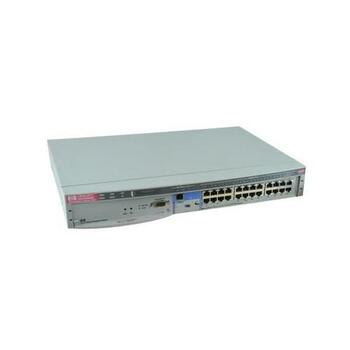
The HP AdvanceStack 224T Switch is a 24-port gigabit Ethernet switch designed to support small to mid-sized network environments. It fits well into office setups or network closets where reliable wired connections and easy network growth are important. This switch streamlines network management by allowing multiple units to be stacked, making it easier to control and configure as the network expands. |
General Information |
|
|---|---|
| Brand | HP |
| Condition | Refurbished |
Technical Information |
|
|---|---|
| Switch Ports | 24 |
| Number of Ports | 24-Ports |
| Port Type | 10/100Base-T, Combo RJ-45/SFP, Serial Console (RJ-45) |
| Port Speed | 10/100 Mbps |
| UpLink Ports | 2 |
| POE Support | No |
| VLAN Support | Yes |
| Max VLANs Supported | 1-4094 |
| Layer Support | Layer 2 |
| Connector Type | RJ-45,SFP |
Management and Configuration |
|
|---|---|
| Remote Protocols | Yes |
| Management Interfaces | Web GUI (HTTP/HTTPS),CLI (Console),SNMP,Telnet |
| Security Features | 802.1X,Access Control Lists (ACLs),Port Security,MAC Authentication |
| Remote Management Protocol | SNMP,HTTP,HTTPS,Telnet |
Physical Characteristics |
|
|---|---|
| Weight | 3.00 |
Product Description |
|---|
The HP AdvanceStack 224T Switch is designed to deliver reliable and efficient network performance with 24 gigabit ports, enabling fast data transfer across devices. This switch is often found in office environments and small to medium-sized business networks, where stable and scalable connectivity is essential. Built for IT teams managing growing networks, it simplifies network expansion by supporting advanced stacking features, allowing multiple switches to operate as a single unit. Key Features
Typically deployed in office networks or data closets, the AdvanceStack 224T switch helps maintain smooth communication between devices. Its stacking ability makes expanding the network easier, while the energy-efficient design keeps operational costs down. It plays a key role in maintaining consistent network uptime and performance for day-to-day business tasks. |
Use Cases |
|---|
The HP 24-Port Gigabit Ethernet AdvanceStack 224T Switch is optimized for small to medium business environments where reliable, high-speed wired connections are essential. It is particularly suited for office networks requiring streamlined management and scalability through stacking capabilities, enabling IT teams to efficiently expand network capacity as demands grow. How It's Used:
This switch enhances operational efficiency by consolidating network management through stacking and providing robust performance for increasing data loads. Its design supports scalability and reliability, which are critical for evolving IT infrastructures in small to medium business settings. |
 Shipping Options
 International Delivery
Requires a UPS, FedEx, or DHL account. Customers may arrange pickup from our US warehouse.
International Delivery
Requires a UPS, FedEx, or DHL account. Customers may arrange pickup from our US warehouse.
 Payment Methods
We accept Visa, Mastercard, AMEX, Discover, and Wire Transfer.
Payment Methods
We accept Visa, Mastercard, AMEX, Discover, and Wire Transfer.
 Purchase Orders
We process purchase orders for government agencies, enterprises, data centers, and SMBs.
Purchase Orders
We process purchase orders for government agencies, enterprises, data centers, and SMBs.