Subscribe To Our Newsletter!
Subscribe to the newsletter to stay up to date with the latest news and most useful
Newsletter
↑
Back to Top



Product Overview |
|---|
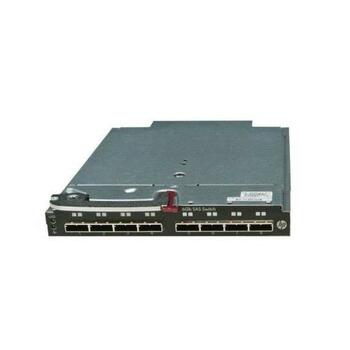
The HP 8-Ports 6Gbps SAS Blade Switch is a specialized networking component designed to fit into HP C-Class BladeSystems. It facilitates high-speed SAS connections within blade servers, enabling efficient storage communication and expansion in compact data center environments. |
General Information |
|
|---|---|
| Brand | HP |
Physical Characteristics |
|
|---|---|
| Condition | Refurbished |
| Weight | 8.50 |
Miscellaneous |
|
|---|---|
| Eco Friendly | Yes |
| Assembly Required | Yes |
| Compliance Standards | WEEE, RoHS, cURus, CE, FCC, CCC, UL, TUV, cULus, CSA, cUL |
Product Description |
|---|
This HP 8-Ports 6Gbps SAS Blade Switch facilitates rapid data exchange between blade servers and storage devices in the C-Class BladeSystem. Its 6Gbps SAS ports ensure swift communication, making it well-suited for storage-intensive applications. Often integrated into data centers and enterprise environments, it is built for IT professionals who require reliable, high-throughput connectivity within their blade server setups. The switch simplifies storage networking by consolidating multiple SAS connections within a single blade. Key Features
This blade switch is commonly deployed in enterprise server rooms where dense, high-speed storage connections are critical. It helps streamline storage infrastructure, improving overall efficiency and simplifying maintenance tasks. |
Use Cases |
|---|
The HP 8-Ports 6Gbps SAS Blade Switch is primarily utilized in data center environments where HP C-Class BladeSystem enclosures are deployed. IT administrators managing high-density blade servers benefit from this switch’s ability to streamline storage connectivity and maintain efficient communication between server blades and attached SAS storage devices. How It's Used:
By consolidating SAS connectivity within the blade chassis, this switch helps maintain operational efficiency and reduces physical cabling complexity. Its role in enabling scalable and high-performance storage communication supports evolving workload demands in dense, modular server environments. |
 Shipping Options
 International Delivery
Requires a UPS, FedEx, or DHL account. Customers may arrange pickup from our US warehouse.
International Delivery
Requires a UPS, FedEx, or DHL account. Customers may arrange pickup from our US warehouse.
 Payment Methods
We accept Visa, Mastercard, AMEX, Discover, and Wire Transfer.
Payment Methods
We accept Visa, Mastercard, AMEX, Discover, and Wire Transfer.
 Purchase Orders
We process purchase orders for government agencies, enterprises, data centers, and SMBs.
Purchase Orders
We process purchase orders for government agencies, enterprises, data centers, and SMBs.