

Subscribe To Our Newsletter!
Subscribe to the newsletter to stay up to date with the latest news and most useful
Newsletter
↑
Back to Top



Product Overview |
|---|
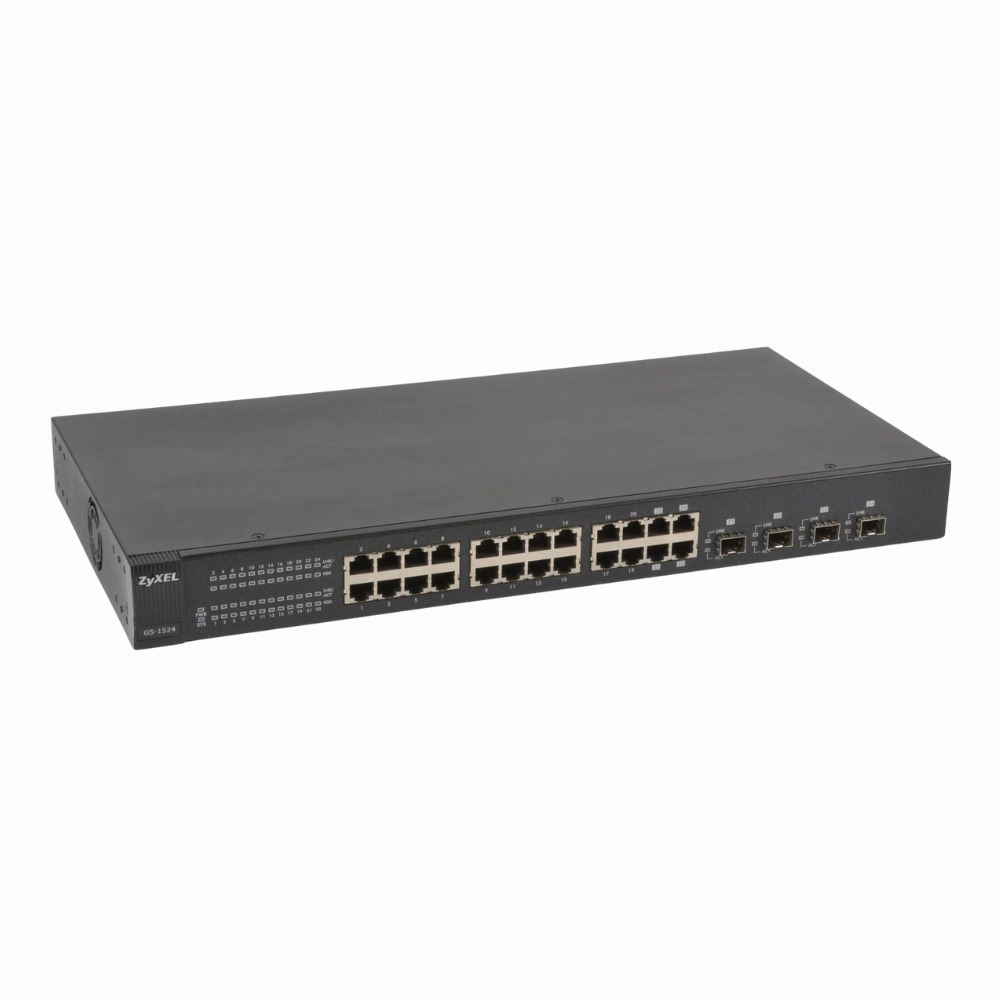
The ZyXEL GS-1524 switch delivers a balance of port density and management features, fitting well in business networks that require gigabit speeds and flexible fiber or copper connectivity. It offers essential Layer 2 capabilities to manage traffic and segment networks while supporting common setups seen in offices and small data centers. |
General Information |
|
|---|---|
| Brand | Zyxel |
| Part Number | GS-1524 |
| Condition | Refurbished |
Technical Information |
|
|---|---|
| Number of Ports | 20-Ports |
| Port Speed | 10/100/1000Base-T (Gigabit Ethernet) |
| Switching Capacity | 48 Gbps |
| Max VLANs Supported | 1-4094 |
Performance |
|
|---|---|
| Jumbo Frame Support | Up To 9216 Bytes |
| MAC Address Table Size | 8K (8192) MAC address table |
Management and Configuration |
|
|---|---|
| Management Type | Web GUI (HTTP/HTTPS), CLI, SNMP |
| Security | 802.1X, ACL (Access Control Lists), Port Security, MAC Filtering |
| Remote Management Protocol | SNMP v1/v2c/v3, RMON, SSH, HTTPS, Telnet |
Physical Characteristics |
|
|---|---|
| Weight | 4.00 |
Miscellaneous |
|
|---|---|
| Eco Friendly | Yes |
| Assembly Required | Yes |
| Compliance Standards | WEEE, RoHS, cURus, CE, FCC, CCC, UL, TUV, cULus, CSA, cUL |
| Compliant Standards | IEEE 802.3, IEEE 802.3u, IEEE 802.3ab, IEEE 802.3z, IEEE 802.3x, IEEE 802.1Q, IEEE 802.1p, IEEE 802.1D, IEEE 802.1w, IEEE 802.3ad (LACP) |
Product Description |
|---|
The ZyXEL GS-1524 is a Layer 2 managed switch built to handle gigabit Ethernet traffic across multiple devices. It’s commonly used in small to medium-sized business networks where reliable wired connectivity and some level of traffic management are important. Typical users include IT administrators who need to control network segments and optimize performance efficiently. Key Features
This switch often appears in office wiring closets, connecting desktop computers, printers, and servers. It helps maintain steady network speeds and provides control over traffic flow, which is crucial for everyday business operations that rely on stable data transmission. |
Use Cases |
|---|
The ZyXEL GS-1524 switch is typically deployed in SMB and enterprise edge networks where robust Layer 2 management and flexible connectivity options are necessary. It serves environments requiring segmented VLANs and reliable gigabit throughput, such as office floors, branch locations, and small data centers handling moderate to high traffic loads. How It's Used:
By providing a versatile and manageable gigabit switching platform, the GS-1524 helps IT teams optimize network segmentation and scaling while maintaining consistent throughput. Its adaptability to different media types and Layer 2 features aligns with operational needs in dynamic business infrastructures. |
 Shipping Options
 International Delivery
Requires a UPS, FedEx, or DHL account. Customers may arrange pickup from our US warehouse.
International Delivery
Requires a UPS, FedEx, or DHL account. Customers may arrange pickup from our US warehouse.
 Payment Methods
We accept Visa, Mastercard, AMEX, Discover, and Wire Transfer.
Payment Methods
We accept Visa, Mastercard, AMEX, Discover, and Wire Transfer.
 Purchase Orders
We process purchase orders for government agencies, enterprises, data centers, and SMBs.
Purchase Orders
We process purchase orders for government agencies, enterprises, data centers, and SMBs.