

Subscribe To Our Newsletter!
Subscribe to the newsletter to stay up to date with the latest news and most useful
Newsletter
↑
Back to Top



Product Overview |
|---|
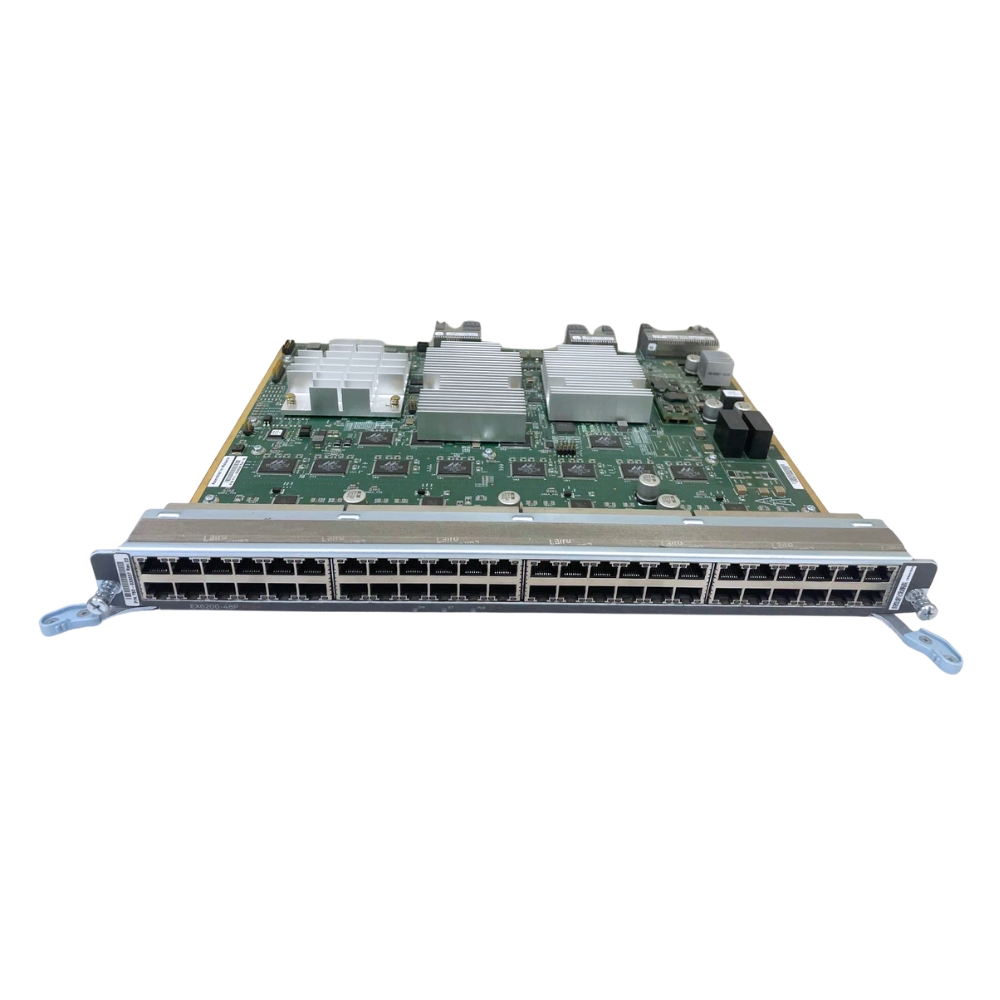
The EX6200-48P module delivers a dense array of gigabit Ethernet ports suited for modular network chassis, supporting various enterprise and data center needs. It fits into existing network frameworks to expand port availability while maintaining stable and efficient data flow without overcomplication. |
General Information |
|
|---|---|
| Brand | Juniper |
Technical Information |
|
|---|---|
| Ports | 48 |
| Compatibility | Juniper EX6200 |
| Data Transfer Rate | 10 Mbps,100 Mbps,1 Gbps |
| Connector Type | RJ-45 |
Physical Characteristics |
|
|---|---|
| Weight | 3.00 |
| Condition | Refurbished |
Miscellaneous |
|
|---|---|
| Assembly Required | No |
| Compliance Standards | RoHS, CE, FCC, UL, cULus |
Product Description |
|---|
The EX6200-48P is a 48-port switch module built for high-performance networking. It's commonly found in modular chassis platforms where dense port counts and efficient data handling are essential. Network administrators and IT professionals benefit from its capacity to deliver consistent, gigabit-level connections across multiple endpoints. Key Features
This switch module plays a critical role in extending and enhancing network infrastructure by providing a solid foundation for bandwidth-intensive tasks. Its reliability and consistent performance make it a practical choice for building scalable and manageable network environments. |
Use Cases |
|---|
The EX6200-48P switch module is typically deployed in medium to large enterprise networks and data centers where high port density and robust gigabit connectivity are critical. It serves environments that require reliable, scalable network expansion within chassis-based infrastructure. How It's Used:
Across these scenarios, the EX6200-48P facilitates efficient handling of network load while supporting infrastructure growth. Its design aids in maintaining network performance consistency as operational demands increase. |
 Shipping Options
 International Delivery
Requires a UPS, FedEx, or DHL account. Customers may arrange pickup from our US warehouse.
International Delivery
Requires a UPS, FedEx, or DHL account. Customers may arrange pickup from our US warehouse.
 Payment Methods
We accept Visa, Mastercard, AMEX, Discover, and Wire Transfer.
Payment Methods
We accept Visa, Mastercard, AMEX, Discover, and Wire Transfer.
 Purchase Orders
We process purchase orders for government agencies, enterprises, data centers, and SMBs.
Purchase Orders
We process purchase orders for government agencies, enterprises, data centers, and SMBs.