Subscribe To Our Newsletter!
Subscribe to the newsletter to stay up to date with the latest news and most useful
Newsletter
↑
Back to Top



Product Overview |
|---|
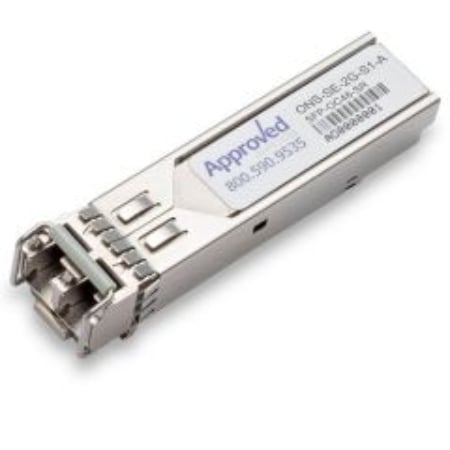
The Cisco 2.5Gb/s OC-48/STM-16 Single-Mode Fiber SFP Transceiver Module is a compact device designed to provide reliable optical connectivity in telecommunications and enterprise networks. It fits into SFP ports on compatible equipment to deliver OC-48/STM-16 transmission over single-mode fiber spanning distances up to 2 kilometers, using a 1310nm wavelength and LC connector type. |
General Information |
|
|---|---|
| Brand | Cisco |
| Part Number | ONS-SE-2G-S1= |
Technical Information |
|
|---|---|
| Form Factor | SFP |
| Media | SMF |
| Type | LX |
| Protocols | OC-48/STM-16 |
| Connector | LC Duplex |
| DOM Support | No |
Physical Characteristics |
|
|---|---|
| Weight | 3.00 |
| Condition | Refurbished |
Product Description |
|---|
This Cisco SFP transceiver module enables high-speed optical communication at 2.5Gb/s, designed for OC-48/STM-16 network applications. It’s commonly used in telecom and data center environments where reliable long-distance fiber connections are needed. Network engineers and service providers rely on this module to extend network reach while maintaining signal integrity. Key Features
This module often appears in carrier-grade equipment and enterprise network setups that require stable, long-range optical links. It helps maintain fast and consistent data throughput across metropolitan or regional network segments, making it a solid choice for sustaining connectivity over fiber infrastructure. |
Use Cases |
|---|
The Cisco 2.5Gb/s OC-48/STM-16 Single-Mode Fiber SFP Transceiver Module is commonly deployed in environments requiring high-speed optical transmission over moderate distances. It is ideal for telecommunications providers, enterprise network infrastructures, and data centers that demand reliable OC-48/STM-16 connectivity with single-mode fiber backbones. How It's Used:
This transceiver supports operational continuity by delivering stable, standardized optical connections that integrate with existing single-mode fiber infrastructure. It aids in maintaining scalable network architectures where moderate distance and consistent bandwidth are critical for application performance and network reliability. |
 Shipping Options
 International Delivery
Requires a UPS, FedEx, or DHL account. Customers may arrange pickup from our US warehouse.
International Delivery
Requires a UPS, FedEx, or DHL account. Customers may arrange pickup from our US warehouse.
 Payment Methods
We accept Visa, Mastercard, AMEX, Discover, and Wire Transfer.
Payment Methods
We accept Visa, Mastercard, AMEX, Discover, and Wire Transfer.
 Purchase Orders
We process purchase orders for government agencies, enterprises, data centers, and SMBs.
Purchase Orders
We process purchase orders for government agencies, enterprises, data centers, and SMBs.