

Subscribe To Our Newsletter!
Subscribe to the newsletter to stay up to date with the latest news and most useful
Newsletter
↑
Back to Top



Product Overview |
|---|
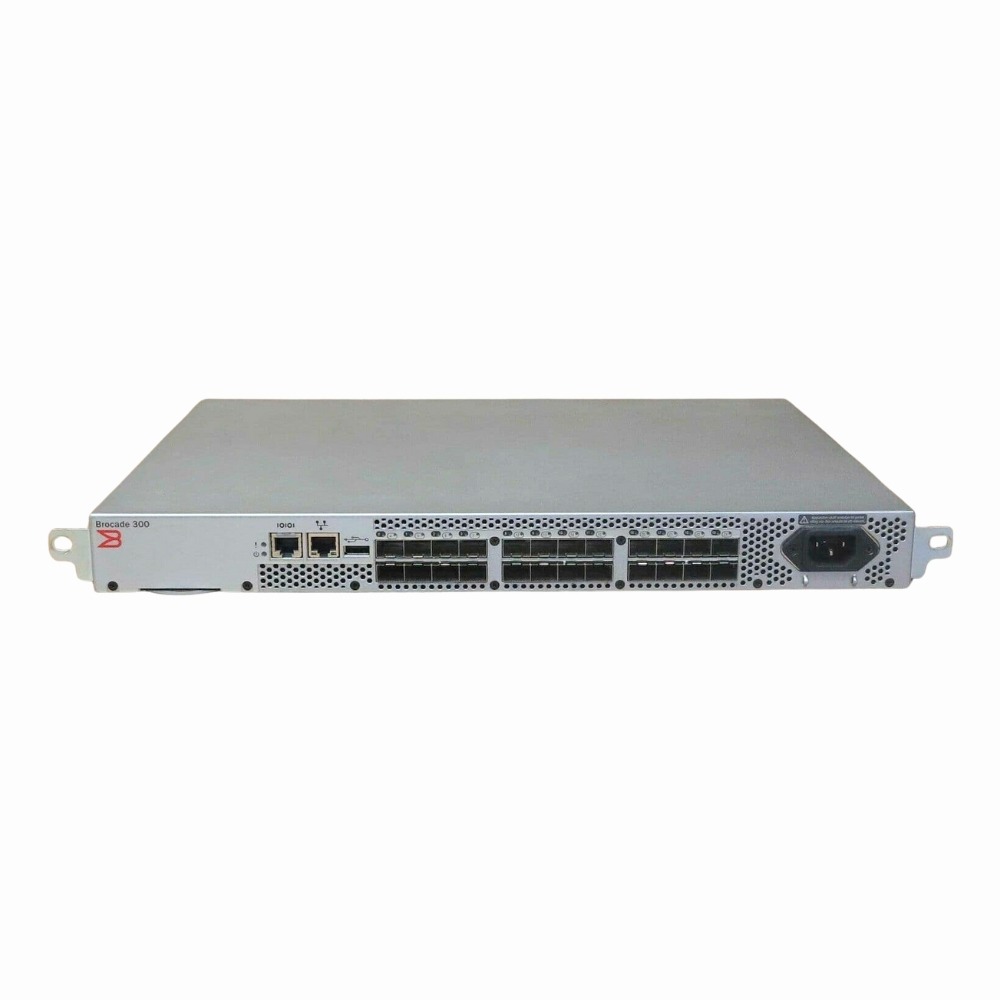
The Brocade 300 8/24 port 8Gb/s Fibre Channel SAN Switch provides reliable storage networking with flexible port options. It fits well in mid-sized SAN setups, offering solid performance for storage traffic without unnecessary complexity. |
General Information |
|
|---|---|
| Brand | Brocade |
| Part Number | BR-300-8 |
| Condition | Refurbished |
Technical Information |
|
|---|---|
| Form Factor | Rack-Mountable |
| Mount Type | 1U Rack |
| Switch Ports | 8 x 8Gb/s Fibre Channel SFP ports |
| Number of Ports | 24-Ports |
| Port Type | SFP |
| Port Speed | 8 Gbps |
| UpLink Ports | 24-port |
| POE Support | No |
| Switching Capacity | 192 Gbps |
| Switch Forwarding Rate | 700 ns |
| VLAN Support | No |
| Stackable | No |
| Layer Support | Layer 2 |
| Connector Type | LC fibre SFP, plus management ports: 10/100 Ethernet RJ‑45, serial RJ‑45, USB |
Management and Configuration |
|
|---|---|
| Remote Protocols | SSH, Telnet, HTTPS/SSL, RADIUS, SNMP v3 |
| Management Interfaces | CLI, Web tools, Fabric Manager, in-band |
| Security Features | Fabric zoning, RSCN, NPIV, classes of service |
| Management Type | CLI,Web GUI,SNMP |
| Remote Management Protocol | SSH,Telnet,HTTP,HTTPS,SNMP |
Physical Characteristics |
|
|---|---|
| Dimensions | 4.29×42.88×30.66 cm |
| Weight | 4.00 |
| Operating Temperature | 0°C to 40°C |
Miscellaneous |
|
|---|---|
| Compliance Standards | RoHS, CE, FCC |
Product Description |
|---|
The Brocade 300 SAN Switch is built for managing storage area networks with speed and efficiency. It’s often found in data centers where quick and reliable data exchange between servers and storage devices is essential. IT administrators and storage professionals rely on this switch to maintain smooth SAN operations. Key Features
This switch typically appears in enterprise storage networks, connecting servers to arrays or tape libraries. It plays a key role in ensuring data moves securely and swiftly, minimizing bottlenecks and keeping storage resources accessible. |
 Shipping Options
 International Delivery
Requires a UPS, FedEx, or DHL account. Customers may arrange pickup from our US warehouse.
International Delivery
Requires a UPS, FedEx, or DHL account. Customers may arrange pickup from our US warehouse.
 Payment Methods
We accept Visa, Mastercard, AMEX, Discover, and Wire Transfer.
Payment Methods
We accept Visa, Mastercard, AMEX, Discover, and Wire Transfer.
 Purchase Orders
We process purchase orders for government agencies, enterprises, data centers, and SMBs.
Purchase Orders
We process purchase orders for government agencies, enterprises, data centers, and SMBs.