

Subscribe To Our Newsletter!
Subscribe to the newsletter to stay up to date with the latest news and most useful
Newsletter
↑
Back to Top



Product Overview |
|---|
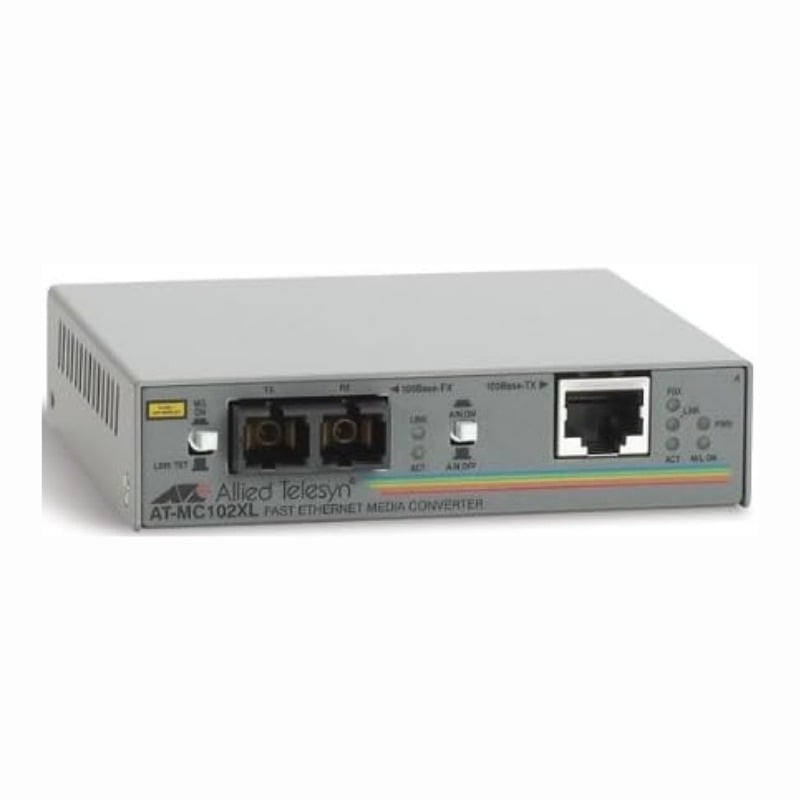
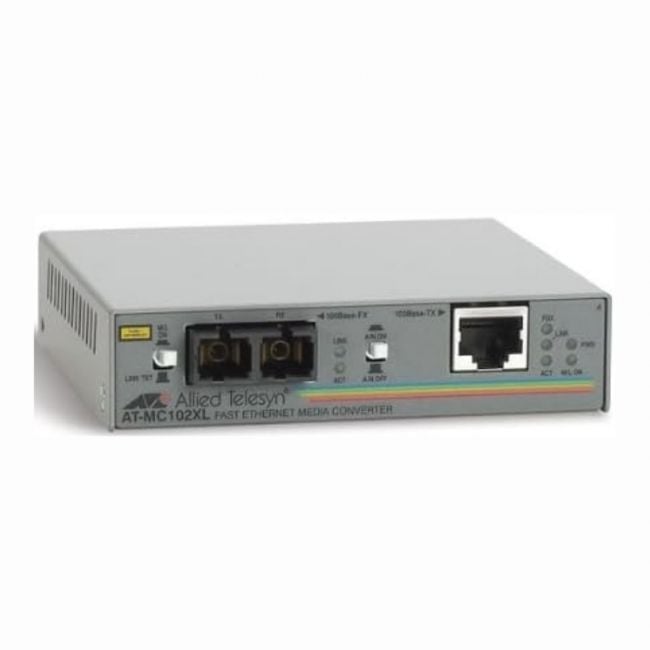
The Allied Telesis AT-MC102XL-90 media converter facilitates the transition between copper and fiber network segments by converting standard 100Base-TX Ethernet signals to fiber optic format. It fits into networks that require extending Ethernet connections beyond typical copper cable limits, providing a straightforward and dependable way to link devices across varying media types. |
General Information |
|
|---|---|
| Brand | Allied Telesis |
| Part Number | AT-MC102XL-90 |
Technical Information |
|
|---|---|
| Series | AT-MC102XL |
| product type | 100Base-TX to 100Base-FX Fast Ethernet Media Converter |
| Product Category | Media Converter |
| Compatibility | 100Base-TX,100Base-FX,IEEE 802.3u (Fast Ethernet) |
Miscellaneous |
|
|---|---|
| Assembly Required | Yes |
| Eco Friendly | Yes |
| Compliance Standards | WEEE, RoHS, cURus, CE, FCC, CCC, UL, TUV, cULus, CSA, cUL |
Physical Characteristics |
|
|---|---|
| Weight | 5.00 |
| Condition | Refurbished |
Product Description |
|---|
The Allied Telesis AT-MC102XL-90 is a media converter designed to bridge copper Ethernet and fiber optic networks seamlessly. It converts 100Base-TX Fast Ethernet signals from twisted-pair cables to fiber, enabling network segments to extend over longer distances without signal degradation. Often found in enterprise or industrial environments where network flexibility and distance extension are essential, this converter is built for network administrators and IT professionals who require dependable connectivity between different media types. It’s a practical solution for connecting devices that lack fiber interfaces or for integrating fiber infrastructure into existing copper networks. Key Features
This media converter is commonly deployed in office buildings, data centers, and campus networks where extending Ethernet over fiber is necessary. It enables reliable communication across different network segments, helping to maintain consistent data flow and reduce downtime. |
Use Cases |
|---|
The Allied Telesis AT-MC102XL-90 media converter is commonly deployed in network environments requiring seamless integration between copper and fiber infrastructure. Organizations facing distance limitations on copper cabling, such as campus networks or remote office connections, benefit from its ability to extend Fast Ethernet connectivity over fiber optics without complex reconfiguration. How It's Used:
This media converter supports operational efficiency by enabling straightforward network extension and media interoperability, ensuring scalability in mixed-media environments. Its use minimizes downtime and infrastructure changes while maintaining network performance and reliability across various enterprise and distributed network scenarios. |
 Shipping Options
 International Delivery
Requires a UPS, FedEx, or DHL account. Customers may arrange pickup from our US warehouse.
International Delivery
Requires a UPS, FedEx, or DHL account. Customers may arrange pickup from our US warehouse.
 Payment Methods
We accept Visa, Mastercard, AMEX, Discover, and Wire Transfer.
Payment Methods
We accept Visa, Mastercard, AMEX, Discover, and Wire Transfer.
 Purchase Orders
We process purchase orders for government agencies, enterprises, data centers, and SMBs.
Purchase Orders
We process purchase orders for government agencies, enterprises, data centers, and SMBs.