

Subscribe To Our Newsletter!
Subscribe to the newsletter to stay up to date with the latest news and most useful
Newsletter
↑
Back to Top



Product Overview |
|---|
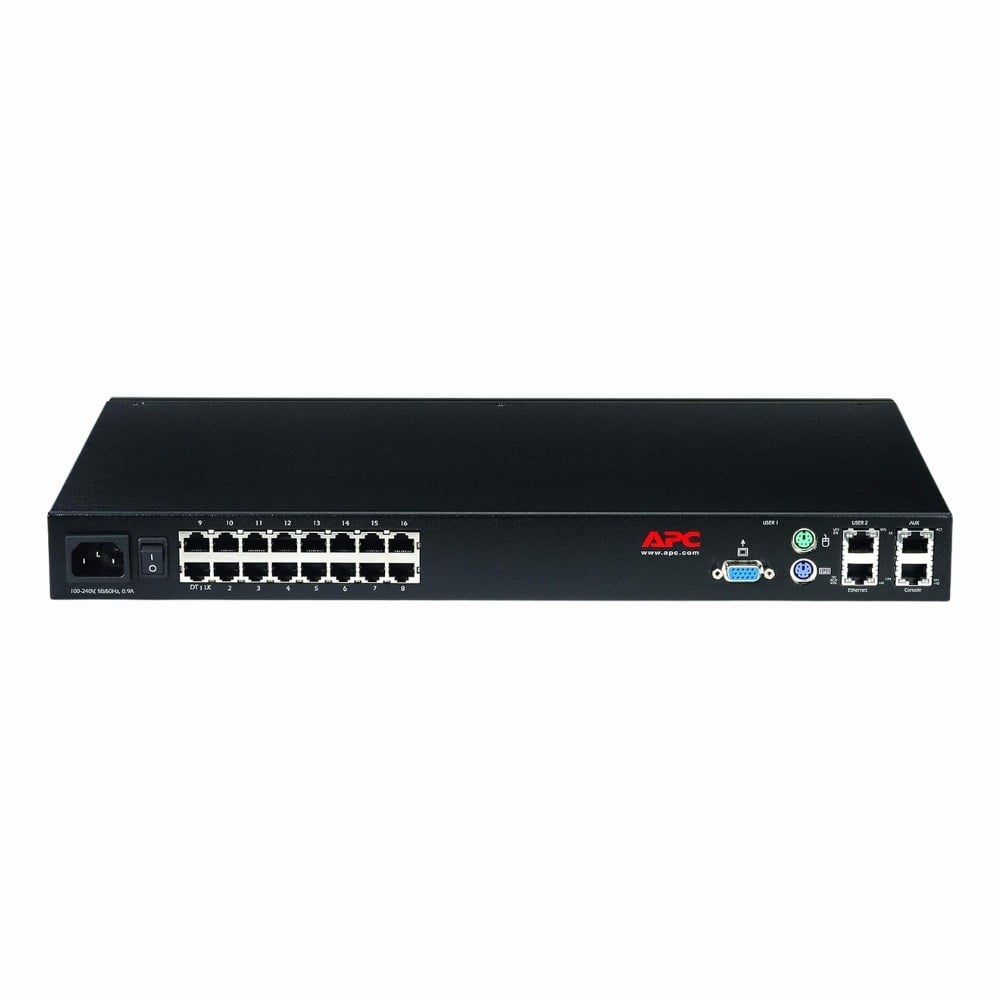
The AP5405 APC 16 x Ports RJ-45 IP KVM Network Switch lets users manage multiple servers remotely through 16 network ports. It fits well in data centers and server rooms, providing a practical way to oversee systems from a distance and streamline server maintenance. |
General Information |
|
|---|---|
| Brand | APC |
| Part Number | AP5405 |
| Product Type | Network Switch |
| Series | AP5405 |
Technical Information |
|
|---|---|
| Ports | 16 x Server KVM Ports |
| Data Rate | Supports PS/2 or USB servers; video resolution depend on modules |
| Compatibility | PS/2 and USB servers via appropriate APC server modules |
| Connector Type | RJ-45 for KVM and management, VGA, PS/2 via server modules |
| product type | KVM Switch,IP KVM Switch,16-Port RJ-45 |
| Product Category | Networking Devices,Network & Accessories,Switches,Network Switches,KVM Switches |
Physical Characteristics |
|
|---|---|
| Form Factor | 1U Rackmount |
| Dimensions | 1.73 x 17.01 x 9.49 in |
| Weight | 4.00 |
| Condition | Refurbished |
Miscellaneous |
|
|---|---|
| Assembly Required | Yes |
| Eco Friendly | Yes |
| Compliance Standards | WEEE, RoHS, cURus, CE, FCC, CCC, UL, TUV, cULus, CSA, cUL |
Product Description |
|---|
The AP5405 APC 16 x Ports RJ-45 IP KVM Network Switch provides centralized control for managing multiple servers or computers via a single console. It is commonly used in data centers and server rooms where administrators need quick and efficient remote access. Built for IT professionals and system administrators, this switch simplifies the monitoring and maintenance of networked devices without requiring physical presence. It is often found in environments that demand secure and reliable server management. Key Features
This switch is typically deployed in server environments where space and access efficiency are priorities. It plays a vital role in reducing downtime by allowing swift remote interventions. By consolidating control over multiple machines, it improves workflow and helps maintain system uptime without the need to be physically present at each device. |
Use Cases |
|---|
The AP5405 APC 16 x Ports RJ-45 IP KVM Network Switch is typically deployed in environments requiring centralized remote server management, such as data centers, colocation facilities, and large enterprise server rooms. It is particularly beneficial for IT administrators and system operators who need secure, reliable access to multiple servers across networked infrastructures without physical presence. How It's Used:
By enabling centralized and remote access to multiple servers, the AP5405 supports operational efficiency and scalability in complex IT infrastructures. Its compact design and high port density facilitate streamlined rack deployments, optimizing space and simplifying ongoing server management tasks. |
 Shipping Options
 International Delivery
Requires a UPS, FedEx, or DHL account. Customers may arrange pickup from our US warehouse.
International Delivery
Requires a UPS, FedEx, or DHL account. Customers may arrange pickup from our US warehouse.
 Payment Methods
We accept Visa, Mastercard, AMEX, Discover, and Wire Transfer.
Payment Methods
We accept Visa, Mastercard, AMEX, Discover, and Wire Transfer.
 Purchase Orders
We process purchase orders for government agencies, enterprises, data centers, and SMBs.
Purchase Orders
We process purchase orders for government agencies, enterprises, data centers, and SMBs.