

Subscribe To Our Newsletter!
Subscribe to the newsletter to stay up to date with the latest news and most useful
Newsletter
↑
Back to Top



Product Overview |
|---|
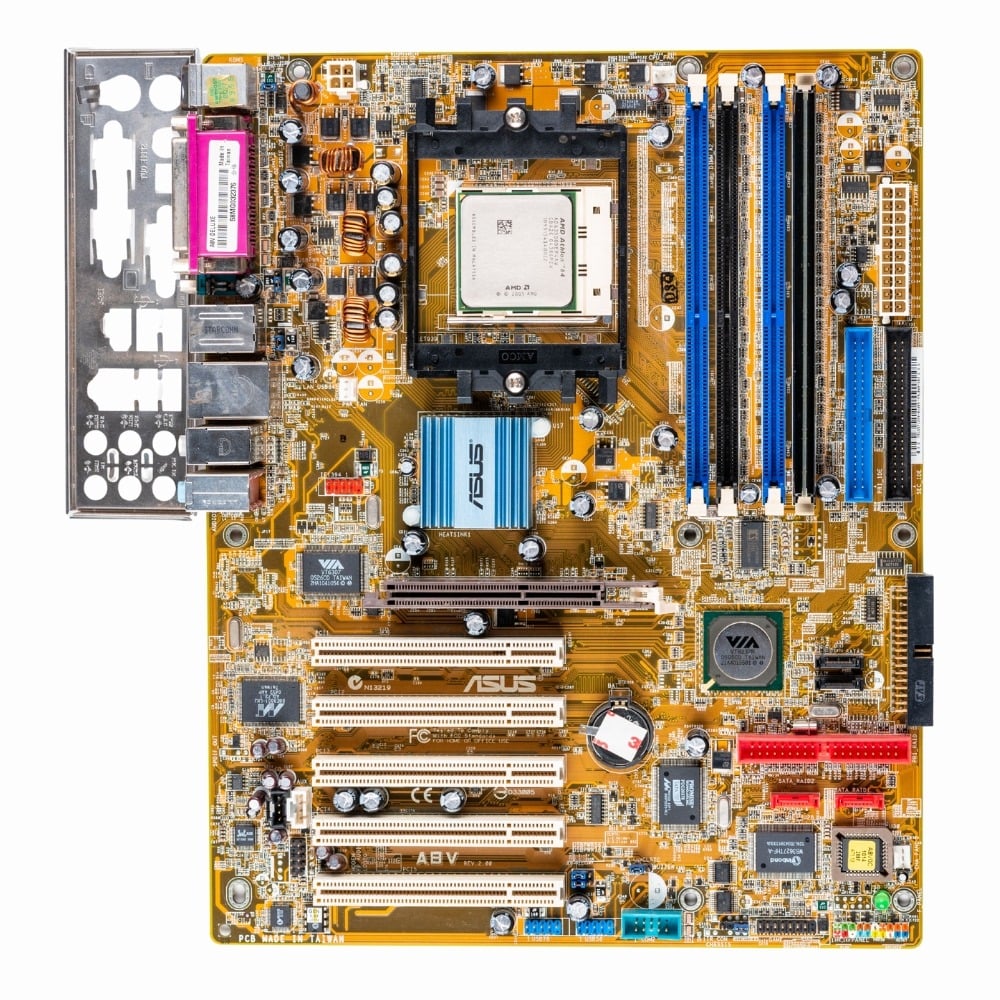
The ASUS A8V Desktop Board supports a variety of AMD processors and fits into standard ATX cases, making it a versatile choice for desktop builds. It handles up to 4GB of DDR SDRAM and relies on the VIA K8T800Pro chipset to provide stable system functionality, commonly suited for general computing environments. |
General Information |
|
|---|---|
| Brand | ASUS |
| Part Number | A8V |
Technical Information |
|
|---|---|
| Chipset | VIA K8T800Pro (with VIA VT8237/VT8237R southbridge) |
| Compatible Processors | AMD Athlon 64, AMD Athlon 64 FX, AMD Athlon 64 X2, AMD Sempron (Socket 939) |
| Board Socket Type | Socket 939 |
| Memory Slots | 4 x DIMM |
| Memory Support | Up to 4GB DDR SDRAM; DDR400 (PC3200), DDR333 (PC2700), DDR266 (PC2100); dual-channel supported |
| Storage Interfaces | Parallel ATA (PATA/IDE, ATA100) - 2 IDE channels (up to 4 devices) |
| Expansion Slots | 1 x AGP 8x, 5 x PCI |
Physical Characteristics |
|
|---|---|
| Form Factor | ATX |
| Dimensions | 305 x 244 mm (standard ATX) |
| Weight | 5.00 |
| Condition | Refurbished |
Miscellaneous |
|
|---|---|
| Assembly Required | Yes |
| Eco Friendly | Yes |
Product Description |
|---|
The ASUS A8V Desktop Board is designed to work with a range of AMD processors including Athlon 64 and Sempron models, providing a solid foundation for desktop computing. It’s often found in home and office PCs that require reliable performance without unnecessary complexity. Built for users looking to assemble or upgrade a desktop system, this motherboard supports up to 4GB of DDR SDRAM, which helps manage multitasking and general computing tasks smoothly. With an ATX form factor, it's compatible with a wide variety of cases, making installation straightforward. Key Features
This motherboard is commonly deployed in budget-conscious desktop setups where dependability is key. It plays a practical role in everyday computing tasks like web browsing, office work, and multimedia playback, serving users who don’t need the latest high-end features but expect solid basic performance. |
Use Cases |
|---|
The ASUS A8V motherboard is optimized for small to medium-sized business desktops and enthusiast workstations, supporting AMD Socket 939 processors to balance cost and performance. It is well-suited for users requiring reliable desktop systems running legacy or specialized software that depends on DDR SDRAM and ATX form factor compatibility. How It's Used:
By supporting a range of AMD processors and standard DDR memory, the A8V motherboard facilitates scalable desktop deployment with consistent performance. Its compatibility with established hardware platforms ensures operational continuity in environments where reliability and cost-efficiency are critical. |
 Shipping Options
 International Delivery
Requires a UPS, FedEx, or DHL account. Customers may arrange pickup from our US warehouse.
International Delivery
Requires a UPS, FedEx, or DHL account. Customers may arrange pickup from our US warehouse.
 Payment Methods
We accept Visa, Mastercard, AMEX, Discover, and Wire Transfer.
Payment Methods
We accept Visa, Mastercard, AMEX, Discover, and Wire Transfer.
 Purchase Orders
We process purchase orders for government agencies, enterprises, data centers, and SMBs.
Purchase Orders
We process purchase orders for government agencies, enterprises, data centers, and SMBs.