

Subscribe To Our Newsletter!
Subscribe to the newsletter to stay up to date with the latest news and most useful
Newsletter
↑
Back to Top



Product Overview |
|---|
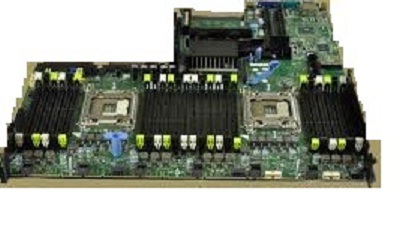
The 46V88 Dell Server Motherboard acts as the central hub for Dell PowerEdge R720 and R720XD servers, coordinating processing, memory, and storage activities. It fits within enterprise servers that require dependable hardware capable of handling intensive workloads and complex applications. |
General Information |
|
|---|---|
| Brand | Dell |
| Part Number | 46V88 |
Technical Information |
|
|---|---|
| Chipset | Intel C600 series (Intel C602/Patsburg) |
| Compatible Processors | Intel Xeon E5-2600 series (Sandy Bridge-EP), Intel Xeon E5-2600 v2 series (Ivy Bridge-EP) (supports up to 2 CPUs) |
| Board Socket Type | LGA 2011 (Socket R) |
| Memory Slots | 24 |
| Memory Support | DDR3 ECC RDIMM, DDR3 ECC LRDIMM, up to 1600 MT/s, up to 768GB (with 32GB LRDIMMs) |
| Storage Interfaces | SATA III (6 Gb/s), SAS 6 Gb/s (via PERC/LSI controllers/backplane) |
| Expansion Slots | PCIe 3.0 x16, PCIe 3.0 x8, mezzanine slot support (for NIC/PERC modules) |
Physical Characteristics |
|
|---|---|
| Form Factor | Proprietary Dell PowerEdge R720/R720XD (2U server motherboard) |
| Weight | 5.00 |
| Condition | Refurbished |
Miscellaneous |
|
|---|---|
| Assembly Required | Yes |
| Eco Friendly | Yes |
Product Description |
|---|
The 46V88 Dell Server Motherboard is designed to serve as the main circuit board for Dell PowerEdge R720 and R720XD servers, managing system resources and communication. It is built to handle enterprise-level workloads, providing the backbone for high-performance computing tasks. Often found in data centers and business environments, this motherboard caters to IT professionals and system administrators who demand reliability and scalability for their servers. Its support for multiple processors and extensive memory capacity allows it to efficiently manage virtualization, database, and application hosting. Key Features
This motherboard is typically deployed within enterprise-grade servers where uptime and performance are critical. It plays a key role in delivering stable operation in virtualized environments, large-scale databases, and cloud computing setups. Its design supports upgrade paths and expansion, making it a lasting component in demanding IT infrastructures. |
 Shipping Options
 International Delivery
Requires a UPS, FedEx, or DHL account. Customers may arrange pickup from our US warehouse.
International Delivery
Requires a UPS, FedEx, or DHL account. Customers may arrange pickup from our US warehouse.
 Payment Methods
We accept Visa, Mastercard, AMEX, Discover, and Wire Transfer.
Payment Methods
We accept Visa, Mastercard, AMEX, Discover, and Wire Transfer.
 Purchase Orders
We process purchase orders for government agencies, enterprises, data centers, and SMBs.
Purchase Orders
We process purchase orders for government agencies, enterprises, data centers, and SMBs.