

Subscribe To Our Newsletter!
Subscribe to the newsletter to stay up to date with the latest news and most useful
Newsletter
↑
Back to Top



Product Overview |
|---|
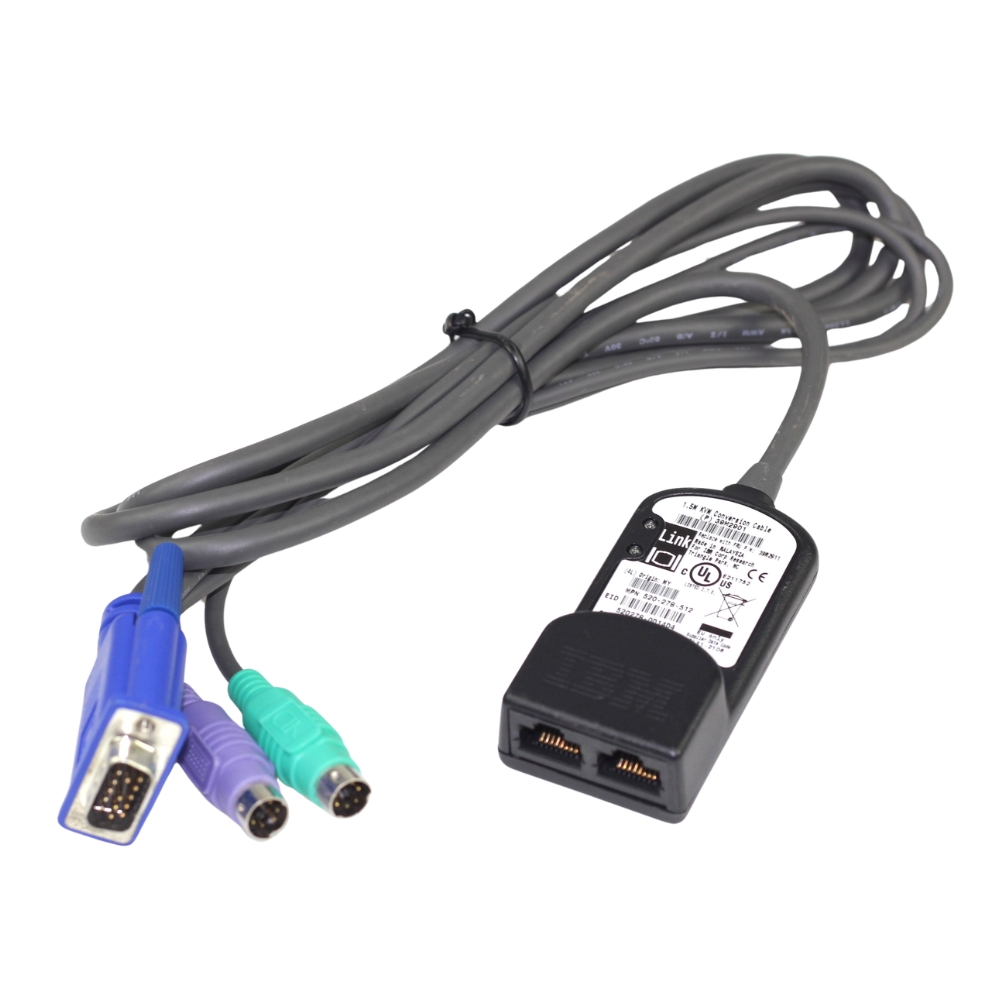
The IBM 1.5-Meters KVM+PS/2 Conversion Cable enables connection between PS/2 keyboards or mice and KVM switches, primarily used in IBM or similar system environments. It acts as a simple bridge, making device integration easier in setups where multiple systems are managed from a single console. |
General Information |
|
|---|---|
| Brand | IBM |
| Part Number | 39M2911 |
| Alternate Part Number | 39M2911-01-UK |
Technical Information |
|
|---|---|
| Cable Family | KVM |
| Cable Type | KVM Cable |
| Cable Length | 1.5 Meters |
| Compatibility | PS/2 keyboard and mouse, VGA monitor, IBM KVM switches |
| product type | KVM + PS/2 Conversion Cable |
| Product Category | Cable |
Connectivity |
|
|---|---|
| Connector A | VGA |
| Connector B | PS/2 |
| Cable Connector Gender | Male to Male |
| Connector Type | VGA, PS/2 |
Physical Characteristics |
|
|---|---|
| Weight | 3.00 |
| Condition | Refurbished |
Product Description |
|---|
This 1.5-meter conversion cable is designed to connect PS/2 devices to KVM switches, allowing easy integration of keyboards and mice into systems that utilize KVM interfaces. It’s often found in server rooms or workstation environments where IBM hardware is in use. Built for IT professionals and system administrators, the cable simplifies setup and reduces the need for additional adapters. Its compact length ensures minimal clutter while maintaining flexibility in device placement. Key Features
Typically deployed in data centers or office setups, this cable plays a straightforward role in connecting legacy input devices to modern KVM infrastructure. Its reliability helps maintain consistent control over multiple systems without frequent hardware swaps. |
Use Cases |
|---|
This cable is intended for use in environments requiring conversion between KVM and PS/2 interfaces. How It's Used:
By employing the 39M2911 cable, users can ensure smooth interoperability between different device standards, simplifying hardware integration and management. |
 Shipping Options
 International Delivery
Requires a UPS, FedEx, or DHL account. Customers may arrange pickup from our US warehouse.
International Delivery
Requires a UPS, FedEx, or DHL account. Customers may arrange pickup from our US warehouse.
 Payment Methods
We accept Visa, Mastercard, AMEX, Discover, and Wire Transfer.
Payment Methods
We accept Visa, Mastercard, AMEX, Discover, and Wire Transfer.
 Purchase Orders
We process purchase orders for government agencies, enterprises, data centers, and SMBs.
Purchase Orders
We process purchase orders for government agencies, enterprises, data centers, and SMBs.