

Subscribe To Our Newsletter!
Subscribe to the newsletter to stay up to date with the latest news and most useful
Newsletter
↑
Back to Top



Product Overview |
|---|
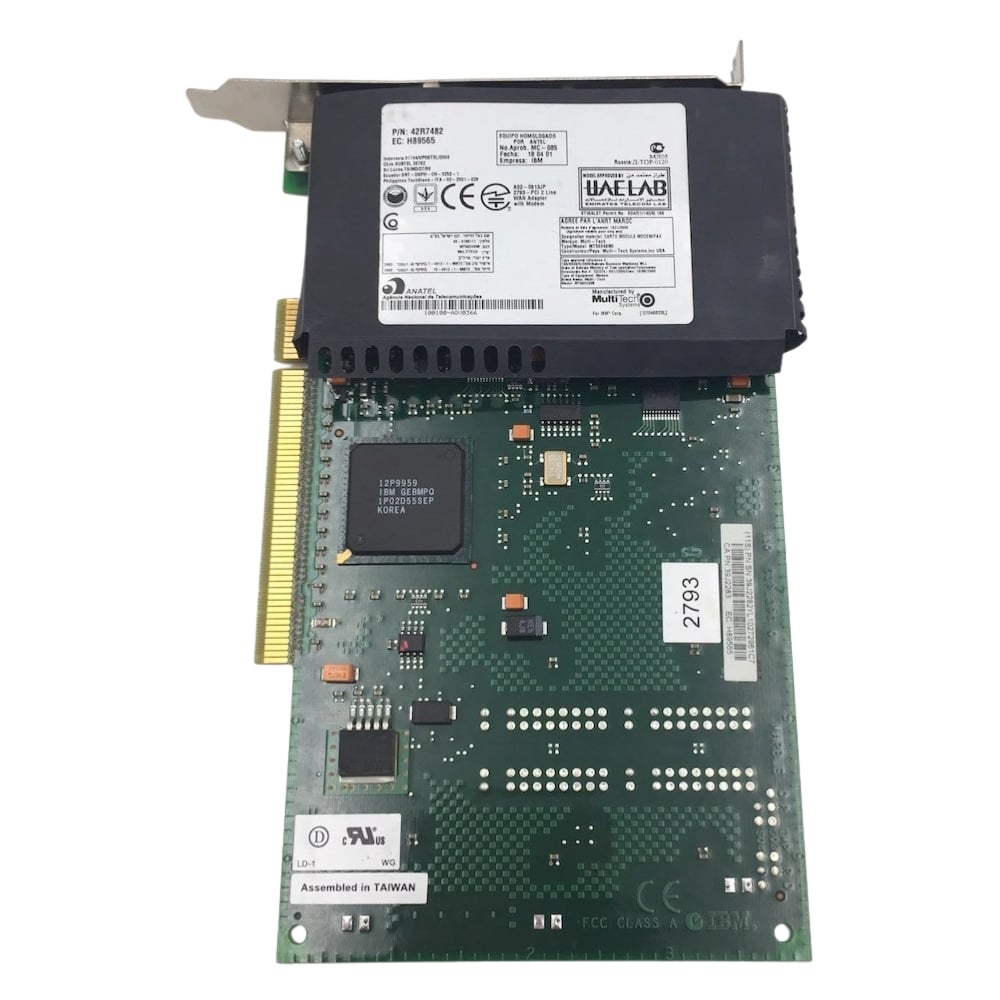
The 39J2283 PCI 2 Line WAN Card with Modem provides dual WAN connectivity along with built-in modem support, enabling a mix of synchronous and asynchronous communications. It fits into IBM server systems and similar platforms, delivering versatile network access without requiring separate hardware for modem services. |
General Information |
|
|---|---|
| Brand | IBM |
Technical Information |
|
|---|---|
| Product Type | Network Interface Card |
| Number of Ports | 2-Port (Dual) |
Connectivity & Physical |
|
|---|---|
| Weight | 3.00 |
| Condition | Refurbished |
Miscellaneous |
|
|---|---|
| Assembly Required | No |
Product Description |
|---|
The 39J2283 PCI 2 Line WAN Card with Modem is built to provide reliable wide area network connectivity for systems requiring dual communication lines. It is commonly used in network setups where both synchronous data transmission and modem-based asynchronous communication are needed. This card is often found in IBM servers and compatible environments, serving IT professionals and network engineers looking to integrate multiple WAN links into their infrastructure. Its design supports both traditional telephony and modern data transmission protocols. Key Features
This WAN card plays a practical role by combining modem functionality with dual-line WAN connectivity, giving systems the flexibility to handle different communication methods efficiently. Its stable performance lends itself to maintaining consistent network operations in mixed connection environments. |
Use Cases |
|---|
This WAN card is typically deployed in enterprise IT environments or data centers where multiple WAN connections are needed for redundancy or diverse network paths. It suits setups requiring integrated modem access alongside high-speed WAN links. How It's Used:
By combining modem and dual WAN line capabilities, this card helps maintain operational efficiency and supports diverse communication demands in complex IT infrastructures. It contributes to scalable network setups and steady connectivity in evolving enterprise environments. |
 Shipping Options
 International Delivery
Requires a UPS, FedEx, or DHL account. Customers may arrange pickup from our US warehouse.
International Delivery
Requires a UPS, FedEx, or DHL account. Customers may arrange pickup from our US warehouse.
 Payment Methods
We accept Visa, Mastercard, AMEX, Discover, and Wire Transfer.
Payment Methods
We accept Visa, Mastercard, AMEX, Discover, and Wire Transfer.
 Purchase Orders
We process purchase orders for government agencies, enterprises, data centers, and SMBs.
Purchase Orders
We process purchase orders for government agencies, enterprises, data centers, and SMBs.